The consensus from our 2023 Book Clubgroups (25 people in total, split evenly between SABBATH by Abraham Joshua Hershel and THE LIGHT WE GIVE by Simran Jeet Singh) is that it would be best to choose ONE BOOK ONLY each year to gather more participants. Late January / early February may be the best time with ZOOM possibilities on weekdays – both afternoon and evening. OFFER YOUR SUGGESTIONS to me NOW or CHOOSE from the titles listed below. Please do not delay so we may get started! Send your responses to jamesdiluzio@gmail.com Here are six book ideas to get us started:
THE RELIGION OF TOMORROW: A Vision for the Future of the Great Traditions – More Inclusive, More Comprehensive, More Complete by Ken Wilbur. This is quite a tome. If chosen, we could discuss half the book in January, the second half in June. The
Alternate Ken Wilbur Book (Much Shorter!) A BRIEF HISTORY OF EVERYTHING
ALL WE CAN SAVE: TRUTH, COURAGE, AND SOLUTIONS FOR THE CLIMATE CRISIS edited by Ayana Elizabeth Johnson and Katherine K. Wilkinson One World; Illustrated edition (September 22, 2020). Named one of the best books of the year by Smithsonian magazine. There is a renaissance blooming in the climate movement: leadership that is more characteristically feminine and more faithfully feminist, rooted in compassion, connection, creativity, and collaboration.. All We Can Save: Truth, Courage, and Solutions for the Climate Crisis by Ayana Elizabeth Johnson, Paperback | Barnes & Noble® (barnesandnoble.com)
Next: Let us entertain some Challenging, perhaps, even Controversial, Ideas:
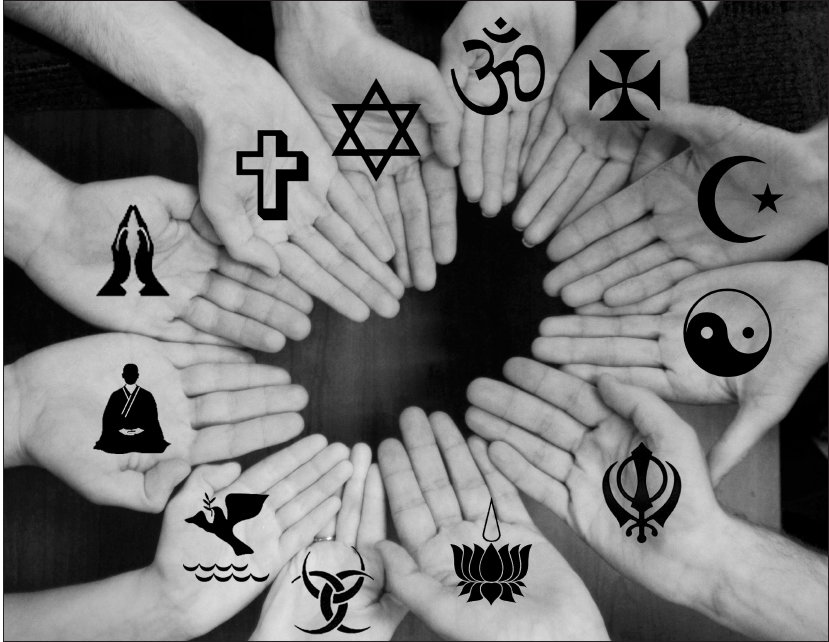
Invitation to Dialogue: I am asking myself lately–especially since I have been speaking with young adults: Is not the ultimate objective of all religion unity with God and others? Agree or disagree? Read on for more particulars and enter into the conversation.
Love of God and Neighbor is a tenet of almost all religions. Yet, we understand God differently. Some conceive God as a Person, a Creative Will, an Ultimate Reality desiring relationship with humanity and all of creation. Others understand God as a spirit of “ultimate good,” “a force,” or “energy,” or an expression of Truth, Beauty, Love, Mercy, Hope, and Justice. Most agree that God desires unity with all peoples in endeavors of love and respect for one and all, and care for our planet. Those who may not accept God often agree that unity, harmony, and peace are the primary goods of life on this earth. Some believe God is to be worshiped, honored, and prayed to, and that this is a necessary religious obligation. Others do not. Participation in “the good,” is sufficient. Therefore:
Is God’s plan, as we understand God, that all peoples celebrate commonalities, and grow in respect of diversity? Is this each faith’s ultimate goal? I.e., is each of us called to affirm the good in all faith traditions without any sense of superiority or supersessionism, and, at the same time, accept the Providence that each of us is called to his/her/their particular faith? Is this what we mean by “surrender to God’s will?” Agree or disagree? Why or why not?
If religious dialogue is a primary way to nurture commonalities and appropriate appreciation of differences among peoples –a path to find solidarity in the good, the true, and the beautiful– is it time we redefine “Righteousness?” Instead of understanding “righteousness” as our adherence to the “right practices” and the correct interpretations of our scriptures, the proper observances of rules and traditions of our personal faith, is true righteousness living in love, humility, and mutual care? Why or why not?
Click the link below to access my blog on The 26th Annual Vaishnava (Hinduism) and Christian Dialogue to explore other aspects of these faith dynamics. Above all consider this statement of agreement between these two faiths; “the DIVINE may never be fully known in human terms,” i.e., God is greater than any of us can conceive.
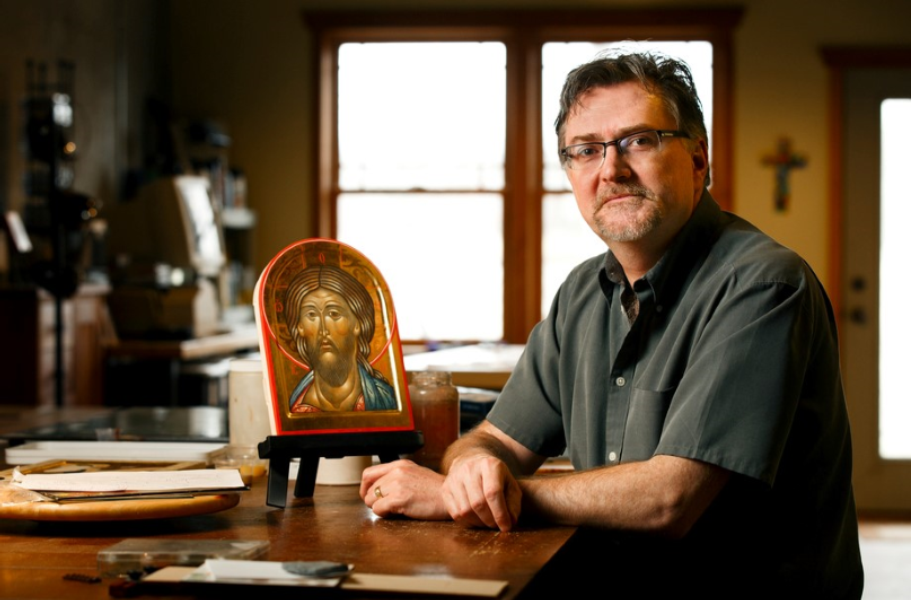
Join in on my conversation with my good friend Nicholas. Then follow along in this blog post to see examples of his latest project in the style of Beuronese Art. I’ve provided explanations for each. Thanks for clicking on this link!
A Brief Bio: Artist Nicholas Markell began his study and practice of religious art and iconography before, but especially during, his five years with the Paulist community in our seminary and while earning an M.Div. from the former Washington Theological Union in Seminary, Washington DC.* He has also studied with professional iconographers from Russia and Eastern Europe. In addition to traditional icons, his work includes stained glass, oil and watercolors, and sculpture. Nicholas’ artwork installed at Saint John Vianney, philosophy department, St. Paul Seminary on the campus of the University of St. Thomas in St. Paul, MN, is featured in all the artwork below.
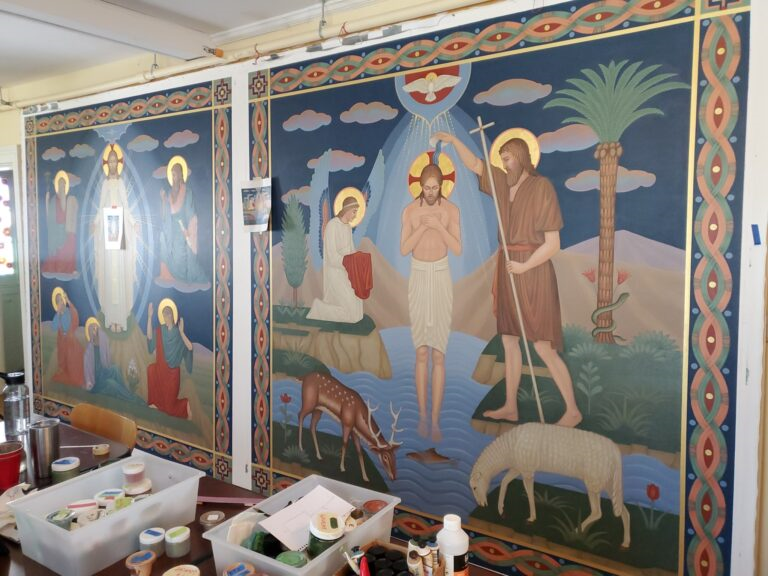
Nicholas’ Art-in-Process
Here’s the Very Basics: 7 Style Standards of Beuronese Art:
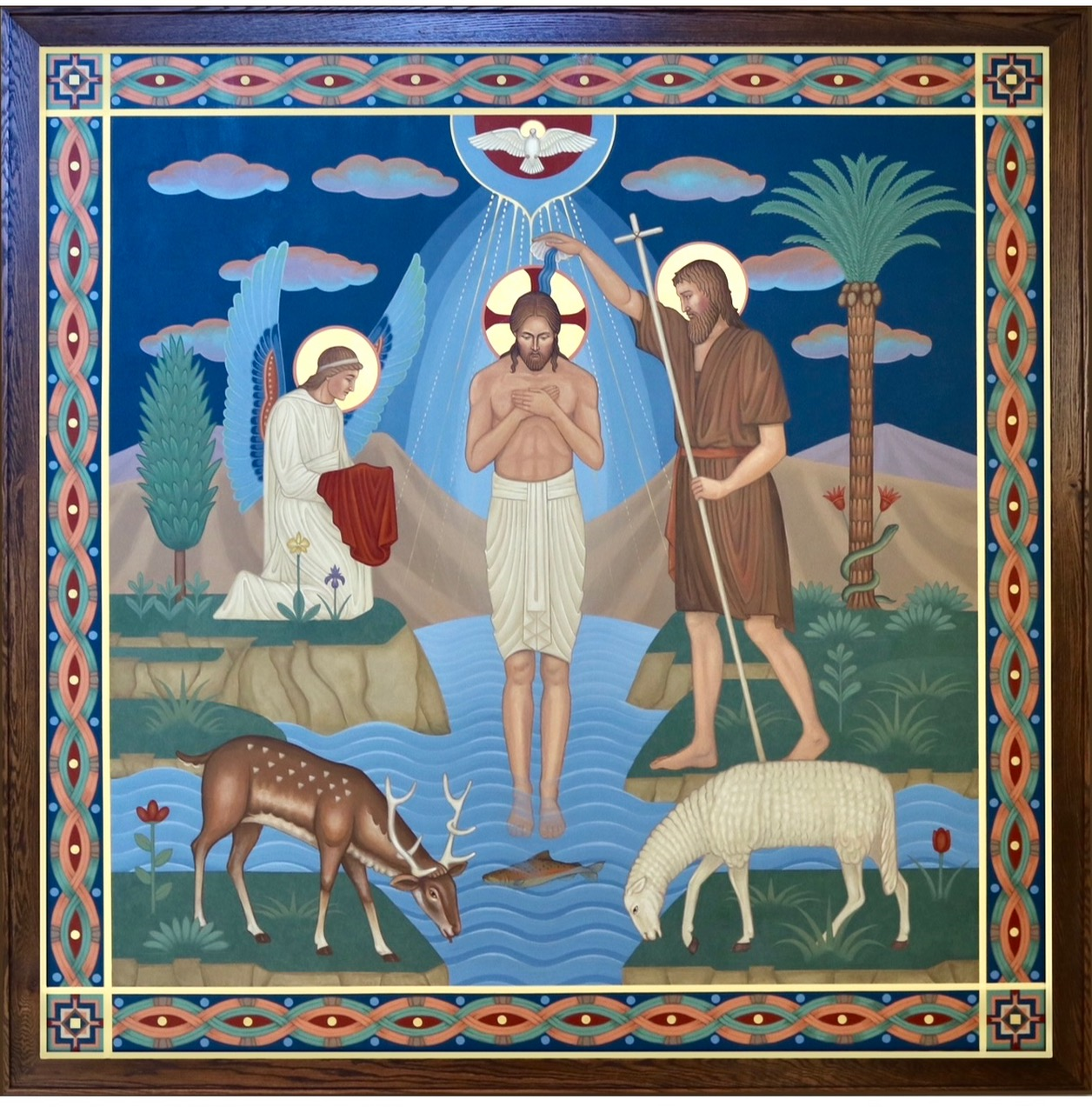
And now, the final work on display: The Baptism of the Lord
Description: The Baptism of Jesus with John the Baptist, and the Dove representing the Holy Spirit of God. The Gospels: Matthew 3: 13 to 17; Mark 1: 9-11; Luke 3: 21-22 describe the event which is implied but not stated directly in John 1:29-34. The angel is most likely Angel Gabriel who announced Messiah’s coming through the Virgin Mary of Nazareth (Luke 1:26-38). Note the Palm tree with a serpent circling the base. This serves as a reminder of Genesis 3, the story of humanity’s temptation to eschew its relationship with God and become our own master. Genesis 3 NABRE – Chapter 3 – Expulsion from Eden. Now – Bible Gateway
The deer and the lamb echo biblical passages, particularly Psalm 42: 2-3 and Habakkuk 3:19 (Jesus being associated the deer who longs for God who give him strength); the lamb linked to the Hebrew Testament’s temple sacrifices and the positive images of shepherd’s, especially David, the former shepherd who came to “shepherd” the people as King of Israel. One of the many titles for Jesus Christ is “Lamb of God.” You may like to explore the many biblical references to “lamb,” “shepherd,” “sheep.” You may begin here: BibleGateway – Keyword Search: Lamb
The HOLY FAMILY
Description: Holy Family at Home. The painting is inspired by a line concluding the pericope Luke 2: 41-52 – the only scripture passage referring to Jesus’s adolescence. Nicholas has depicted the Virgin Mary and Saint Joseph instructing Jesus in the Hebrew Scriptures. Joseph holds a flowering staff — the Lily symbolizing purity as in Catholic and Orthodox Christian teaching that Joseph was a chaste spouse to Mary. The staff comes from a longstanding tradition describing how the temple priests chose Joseph to be Mary’s spouse and benefactor. It is the stuff of legend, not scripture or Church teaching, but it is of literary importance:
“When no man’s staff flowered, the elders again consulted the Lord and the angel’s voice betrayed Joseph. Joseph then brought forth his staff which immediately blossomed with lilies and the Holy Spirit perched upon it in the form of a dove. In this way, Joseph was chosen by God to be the husband of Mary.”
A note from Nicholas Markell: The Holy Family mural, also called The Hidden Life of Jesus, has the most symbolism of the art pieces shown. In addition to those described above, take note of:
The Holy Trinity
Jesus, the Holy Spirit as Dove, and Hand of God the Father.
Archangel Gabriel
Jesus’ Guardian Angel also featured in the Baptism mural above.
Vessels of Frankincense, Myrrh, and Gold on the wall and the Incense Censer Boat on a stand – all to Mary’s right. See Matthew’s Gospel 2 vs 1 to 12.
Bread and Grapes – Eucharist and Passover elements
Rose, Lamb, and a Corner of the Manger behind Jesus at his feet
Rose signifies both Beauty and Suffering. Its thorns reference the crown of thorns will be part of Jesus’ passion.
The Lamb and Manger both reference the Christmas Story, i.e., Jesus’ birth in Luke Chapter 2 vs 1 to 20.
Instruments of Crucifixion
Carpenters’ tools on the wall at Joseph’s left.
Water urn and basin at Joseph’s feet
Water vessels symbolize baptism; the earthen jar also alludes to the Miracle of water-turned-to-wine at the Wedding of Cana in John’s Gospel 2: 1-12.
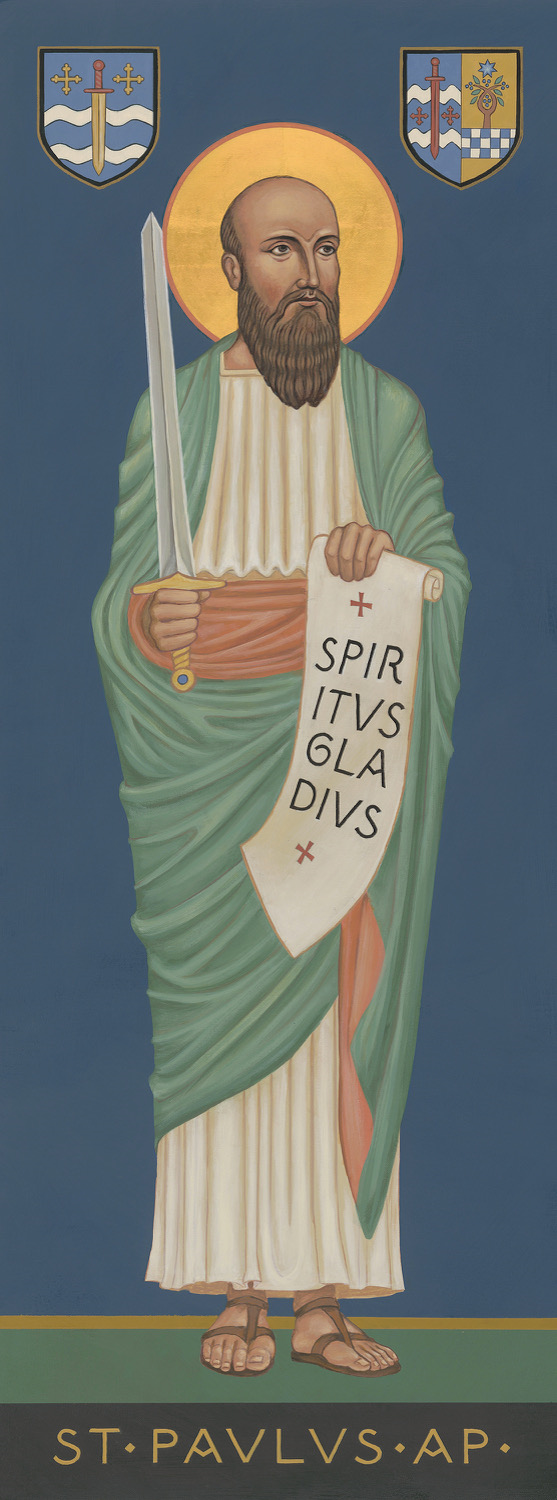
Saint Paul the Apostle
Description: Saint Paul the Apostle is known as the evangelizer to the Gentiles. His missionary journeys, preaching, and letters that form the lengthiest segment of the Christian Testament, expanded the community of Jesus’ followers from a uniquely Jewish sect to a world-wide religion.
St. John Vianney
Description:St. John Vianney, in full Saint Jean-Baptiste-Marie Vianney, also called Curé d’Ars, (born May 8, 1786, Dardilly, France—died August 4, 1859, Ars; canonized May 31, 1925; feast day August 4 [formerly August 9]), a French priest.
Part Five of a “You Are There” experience at the Summit on Pluralism by reviewing these notes submitted by Paulist Father John Geaney and consolidated in bullet points by Yours Truly. Find links to presenters and panelists for your own edification.
DAY TWO Conclusion: Friday 24 June 2023
BREAK OUT SEGMENT # 6PANEL | Strengthening the Diverse Religious Ecosystem
See the links provided for each of the above speakers for examples of their presentation’s content.
Fr. Geaney’s Personal Note:
The final Plenary Session was held during lunch. The format was a sit-down conversation with people of various faiths including Catholics, Jews, Muslims, Sikhs etc, in a truly interfaith witness.
Part Four of a “You Are There” experience at the Summit on Pluralism by reviewing these notes submitted by Paulist Father John Geaney and consolidated in bullet points by Yours Truly. Find links to presenters and panelists for your own edification.
DAY TWO: Friday 24 June 2023
Plenary Session # 1: A Discussion on Religion and Philanthropy
See the links provided for each of the above speakers for examples of their presentation’s content.
BREAK OUT SEGMENT # 5
INTERACTIVE PRESENTATION | From Marginalization to Inclusivity: How online spaces can be transformed from places of isolation to platforms of proud and inclusive religious narratives for youth.
Rabbi Yeudah Potak works with staff at FACING HISTORY AND OURSELVES and offered examples of the ways FH&O transforms online spaces from places of isolation to platforms of proud and inclusive religious narratives for youth. The concern here is to deal as effectively as possible with young people and train them to deal with the “hate” for Jews and other minorities that they see in their everyday negotiating on “the net.”
FH&O has hundreds of employees who work from various offices located in seven major USA cities, and interact with staff aligned with similar agencies in seven countries on five continents. See Locations | Facing History & Ourselves
Fr. Geaney’s Personal Note:
FH&O outreach and its impact are amazing. Rabbi Potak’s presentation flabbergasted me with the stats he presented. I was amazed as to the extent people on the net could be as “nasty” as they are toward Jews even when made aware of the history of the Second World War and the terror of Hitler’s regime.
Audience participation excelled in this break-out session. It is so good to know that our Jewish brothers and sisters are doing as much to assist – especially the young– to influence “the net” in respectful but necessary ways to tell the truth about Jews, their religion, and the terror of current day antisemitism.
Part Three of a “You Are There” experience at the Summit on Pluralism by reviewing these notes submitted by Paulist Father John Geaney and consolidated in bullet points by Yours Truly. Find links to presenters and panelists for your own edification.
DAY ONE CONTINUED: Thursday 23 June 2023
BREAK OUT SEGMENT # 3 Overcoming Racism: The Role of Religion and the Faith Community.
To me, PJ Andrews seemed almost overwhelmed engaging in the Baha’i commitment to bring all faiths to confront racism. Trying to bring interfaith religions together, particularly around difficult issues is an unsettling journey at least.
BREAK OUT SEGMENT # 4 PANEL DISCUSSION: Pope Francis, Pluralism and Polarization: Opportunities and Challenges in the Catholic Community
Presenters:
John Carr, Initiative on Catholic Social Thought and Public Life Georgetown University, John Carr (georgetown.edu)
The leader of the session was John Carr, formerly the Director of the USCCB Office of Social Justice. He offered an expert overview of the Second Vatican Council, highlighting its successes and failures in living up to its vision thus far. (A transcript of his talk may be made available in the future.)
Father Aaron Wessman, Glenmary Home Missioners Vicar General Robert Aaron Wessman, G.H.M. | America Magazine Father Aaron Wessman, the Vicar General of Glenmary, gave an educated and thoughtful prognostication of the Synodality endeavor and future Church
See the links provided for each of the above speakers for examples of their presentation’s content.
DAY ONE Evening Dinner Presentation
Leader: Church of God Bishop Dwayne Royster of Philadelphia
Fr. Geaney’s Personal Note:
Bishop Royster carried his bible to the podium and delivered a powerful sermon urging us to be more loving of each other and lead our people into a less difficult world.
The audience was attentive and appropriately captivated.
This concludes Part Three of the Report on the Pluralism Summit. Scroll back to the top of the page and click “NEXT” for Part Four.
Give Yourself a “You Are There” experience at the Summit on Pluralism by reviewing these notes submitted by Paulist Father John Geaney and consolidated in bullet points by Yours Truly. Find links to presenters and panelists for your own edification.
DAY ONE: Thursday 23 June 2023
Plenary Session: Whose Story Do we tell?
The Challenges and Importance of Accurate Religion Reporting and Story Telling. As per the published Agenda cited above, Summit organizers offered participants several choices for each Breakout segment. Fr. Geaney attended the following: Leveling the Public Square: Reporting on Religion in a Multifaith Society
43% of people surveyed feel coverage of religion causes anxiety for readers.
56% of people believe coverage of religion makes reality more complex, rather than less so.
But 84% of people feel that religion should provide spokespeople when media chooses to cover religion.
Fr. Geaney’s Personal Notes:
The opening session was of great interest to me because I believe Churches do not, in general, do a good job of reporting the story of religion to the media or across the various platforms available to people.)
United States Conference of Catholic Bishops (USCCB) closed Catholic News Service in the past year. This decision of the Bishops is clearly in opposition to the surveys.)
While there were many religions represented among the speakers, there was less description of what needs to be done than I expected.
Give Yourself a “You Are There” experience at the Summit on Pluralism by reviewing these notes submitted by Paulist Father John Geaney and consolidated in bullet points by Yours Truly. Find links to presenters and panelists for your own edification.
Sponsoring Organization The Aspen Institute convened at the International Hotel Washington DC “the Wharf.”
“I was surprised at the depth of the reflections and enjoyed the different ways that each faith person expressed the importance of contemplation to them and their various techniques in pursuing contemplation.
“Each person at the dinner table then was asked to reflect on their own contemplation techniques, and I thought it interesting that all the people at our table responded with reflections about their own method of contemplation. A few did admit that they did not always think ‘contemplation’ when they used a walk to get in touch with God.”
Here’s the SHORT TAKE of a local community meeting I attended.
Date: 13 June 2023 Place: Saint Francis Xavier Catholic Church, 55 West 15th Street, New York NY 10011
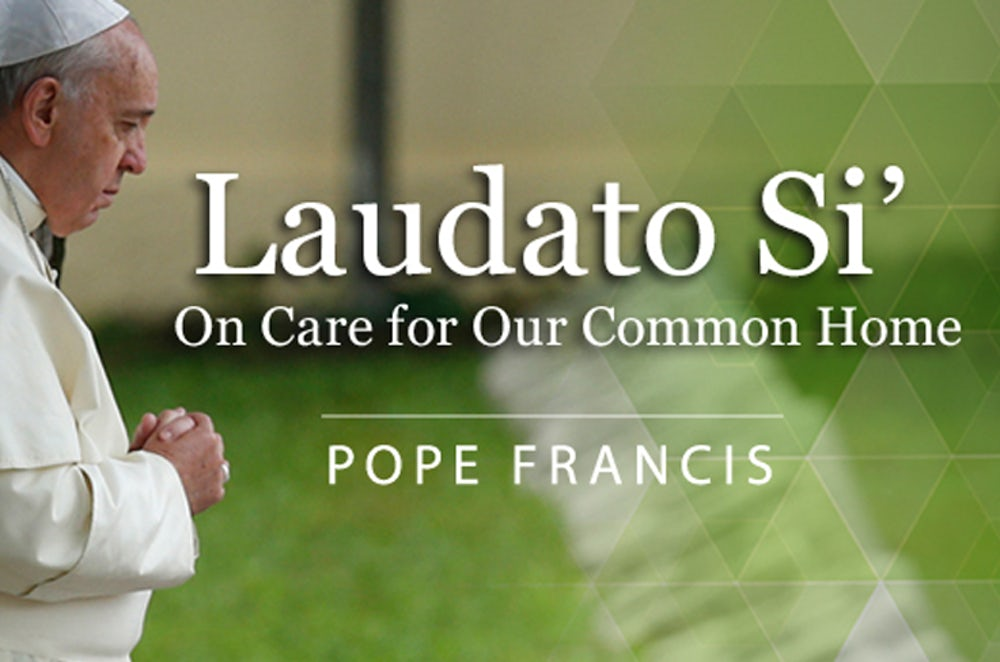
Saint Francis Xavier is a Laudato Si Parish inviting representatives from other parishes and congregations to join in the Laudato Si movement, and/or share initiatives in which they are engaged that address global warming. See: Who we are – Laudato Si’ Movement (laudatosimovement.org)
Presenters:
Dr. Lorna Gold, a member of the Laudato Si Board of Directors, and Board Members of FaithInvest – an international, not-for-profit network of religious groups and faith-based institutional investors, with particular attention to organizations in a healthy relationship to the environment. Network of values-driven, faith-consistent investors | www.faithinvest.org
Dr. Martin G. Palmer, co-founder and C.E.O, of FaithInvest, an outgrowth of Great Britain’s now-defunct Alliance of Religions and Conservation. Palmer is a theologian, Sinologist, author, and international specialist on all major faiths and religious traditions and cultures.
The Short Take:
85 % of the World’s Population is faith-based. Faith organizations are primed for Environmental Action.
2023: 1,000 Catholic organizations have adopted Laudato Si initiatives in their education work
Religious Organizations are the 5th Largest Group in the World – investing in Eco-Friendly businesses will make a tremendous impact.
Divesting in Fossil Fuel Companies is essential. However, selling off stock that others purchase continues to perpetuate the problem. Religious Leaders must work with Government Agencies to create Non-proliferation Treaties.
Invite your congregations to read and discuss “Points of Progress” series featured in the Christian Science Monitor which has an excellent record in Climate Change coverage
Title: Resilience and Resolve: A Climate Justice Training for New York City Faith Communities Sponsored by The Union Theological Seminary Center for Earth Ethics, NYC 10027 https://centerforearthethics.org/resilience-and-resolve/
Identify and significantly reduce Greenhouse Gases
A Good Model for Creating Human Industrial Contributions to Climate Change Initiatives: 1980’s World Response to Ozone Layer Deterioration – Pros & Cons
Jewish Call to Climate Action continues to raise climate extreme’s impact on refugees and on racial and ethnic justice issues. Jewish Call for Climate Action | Hazon
Topic 2: FAITH COMMUNITIES CAN MAKE SIGNIFICANT CONTRIBUTIONS
Presentations and Discussions among participants elicited the following:
Faith communities offer a significant Prophetic Voice to inspire social initiatives to combat global warming by emphasizing the Judaic-Christian outlook of hopeful, forward-looking, transformational world views for peace and collaboration, and citing similar goals in other faith traditions. Emphasize
The Values of Resilience, Fortitude.Courage in Calamity. What is now is definitely NOT what we can be.
The Bible and many faith traditions’ histories evidence a very Healthy Criticism of Power Structures. Thank you, prophets! Similarly, this generation must offer a public voice to the consequences of laws and procedures that prevent or inhibit local communities’ access to clean air and fresh water.
Humbly acknowledge and RECTIFY the results of the history of religious institutions becoming co-opted by power structures. Provide evidence of these events and offer prescriptions to remedy the patterns of this dubious alignment. Inspire your congregation to show visible signs of concern for Future Generations
Assure congregations that Conflicts are Opportunities, and these challenges are prophetic calls for change. Remember this: It often takes THREE repetitions in a public statement, homily, or sermon for people to remember it.
Address the psychological and social dynamics of fear and denial contributing to apathy, lack of compassion, isolation, and social collapse evident in faith traditions’ scriptures and religious history.
In Islam, adherents are reminded of what is called “The Providential Consequence of Corruption in the Land” as the impetus for the people’s return to righteousness.
Observant Muslims are required to donate 2.5% of their income to charity. Question: How does this compare to your congregations’ charitable giving? Can you promote a healthy spirit of competition? The time for Charity toward the Earth is now!
Concerns about Pollution factor need more attention:
PromoteINTERSECTIONALITY Inquire and learn from the people most impacted by events of natural and industrial disasters and experience the burdens of local, state, and federal legislation.
Undocumented workers, refugees, and marginalized neighborhoods are often ignored by health and safety regulators; they often suffer the most from working in the heat.
“No one left behind” is not today’s reality but it can be!
Create “Communities of Care”
Conduct town meetings for people to work through emotions associated with climate change denial or apathy, ideally facilitated by a psychologist. The goal is to help people relate their grief and disappointment and fears that their current life patterns and relationship to nature need to change.
Investigate and share everyone’s “Zone of Resilience.”
Follow up with Mental Wellness Techniques and offer sessions that affirm “we bear the stress together.” We need to “heal past the ‘Us’ that we are, and “collaborate forward” to a better future.
Emphasize that we already HAVE the Science and Technology to address the human contribution to Climate Change.
Highlight HUMILITY, JUSTICE, and STEWARDSHIP passages in faith traditions – all that contributes to “Our common humanity,” and “Reverence and care for Creation.”
EMULATE AND MODIFY AS NEEDED
Study other institutions’ ACTION PLANS and adapt them to your congregation’s and community’s needs.
Follow the example of the VATICAN’s recent disavowal of the Medieval “Doctrine of Discovery” and encourage conversation as to how contemporary institutions can reverse the curses of history.
Abandon all Colonial Imperialistic Responses to Crises.
Study and promote accurate history and report on positive movements in relation to indigenous peoples, e.g. the Taíno movement. “This movement challenges the prevalent belief that Native peoples became extinct shortly after European colonization in the Greater Antilles. It is spurring a regeneration of Indigenous identity within the racially mixed and culturally blended societies of Cuba, the Dominican Republic, and Puerto Rico, as well as other areas of the Caribbean.” Taíno: Native Heritage and Identity in the Caribbean | Taíno: herencia e identidad indígena en el Caribe | National Museum of the American Indian (si.edu)
Australia is currently an excellent prototype for Positive Climate Legislation (Input from Al Gore.)
DO SOME RESEARCH:
Research African, Methodist, and Episcopal Church (AME)’s Resolutions on GREEN THEOLOGY and Practice.
Elicit congregants’ participation in Earth-themed Music and Art Presentations
Study and emulate in consciousness and action Native and Indigenous peoples’ intimate relationship with Nature – past and present.
Research Available Local and Federal Government Grants for Institutions (including Religious Institutions) adopting GREEN INITIATIVES.
Topic 3: CLIMATE COMMUNICATION
Presenter: Al Gore
The goal is to move from perplexity to simplicity in language, visuals, and concepts, and to remain Positive and Hopeful about change for the better.
90% of Coal and Gas can be converted to solar and wind power readily.Solar Power is now the cheapest alternative worldwide.
HOPEFUL REALITY: World Temperature Rise can be halted within three years’ time and if policies and procedures change immediately to non-pollutant energy sources and industrial waste is prevented to reach a NET ZERO factor in human / industrial (including Automobile and transportation) contributions to climate change
To stay at Net Zero: 50% of Carbon Dioxide (CO2) will fall out of the atmosphere in as little as 20 to 30 years.
Religious Institutions are already primed to promote the message: “What we take, we give back.” Address the ways USA government historically has promoted the commodification of peoples and of nature – the dark side of “Discovery.”
Re-examine government policies such as the injustices of “The Jones Act” forcing people of Puerto Rico to import 85% of their foodstuffs whereas the island is capable of producing its own food.
o The Climate Reality Project Our mission is to catalyze a global solution to the climate crisis by making urgent action a necessity across every sector of society.
National Preparedness Report (fema.gov) See pages 8 through 10 for information directly related to Climate Change: FEMA Region 2 National Preparedness Division: Climate Adaptation for Houses of Worship NOTE: FEMA does not give “Disaster Designation” to Heat Waves at this time
Description: While much has been made of the intimate connection between inattention to place and the ecological crisis, very little attention has been given to the troublingly intimate relation between racial reasoning and the denial and destruction of place-centered identity. Dr. Willie James Jennings has been a pioneer in thinking through this neglected topic. Join Dr. Jennings in conversation with John J. Thatamanil, Director of Union’s Insight Project, as they take up this urgent topic.




















 frjamesdiluzio