Stop Anti-Semitism & Scapegoating NOW!

Are you as saddened and outraged about what has happened at Oberlin College in Ohio  as I am?
An adjunct professor spews anti-Semitic, racial hatred in class and on Facebook. The College President allows it because of “freedom of speech” but  in his speech addressing the issue, he does not specify all that is illogical in the anti-Semite professor’s diatribes. Here’s my response and warning to myself and to all of us tempted to scapegoat, blame or ostracize any group AND our responsibility to counter lies and the dark myths of prejudice:
1. We must never speak about any ethnic, national or religious group as responsible for any one thing in particular. Every group is made up of individuals, sub-groups and marginal groups who evidence tremendous diversity .  When anyone speaks of “The Catholics,” “The Protestants,” “the Jews,” The Nigerians,”  “the Americans”  ” the Italians,” we must immediately STOP RIGHT THERE and ask, “Who?”  “Which ones?”  “What segment?” As soon as any one generalizes about any peoples, nation or religion the statement is a LIE!
2.  Even when a sub-group, or smaller group of individuals or individuals themselves are identified as guilty of an immoral incident or event, questions must be addressed and allegations must be verified and substantiated.  Again, “Who?”  “What Contexts?”  “What evidence?”  “What verifications?”  If No ONE can be substantiated as  responsible, then certainly NO ENTIRE GROUP can be responsible. Furthermore, even when ONE individual or Sub-Group is verifiably responsible, it is extremely unlikely that the entire sub-group is responsible and certainly not the entire, larger group.  THIS I S LOGIC.  This is Justice.  This is TRUTH.
3.  Freedom of Speech does allow for anyone to say anything including spewing of  lies, illogic, hatred, prejudice, etc. but a free society has an OBLIGATION to counter that speech with TRUTH.  Furthermore, we have a moral imperative to substantiate the truth with proofs and verifiable historic and scientific evidence.  Therefore, I repeat: Allowing one person’s freedom of speech to include lies, hate, scapegoating requires others to RESPONSIBILITY and to TRUTH.   In the case cited, the President must conduct a public forum revealing the lies of the given professor’s statements. To allow proliferation of a lie is to renege on responsibility and common human decency and allow the lies to prosper, mislead and corrupt people’s thinking.
4.  Even Free Speech has its limits. The public square no longer tolerates racial slurs in the public forums.  Certain expletives are band in the media.  So, too, must negative generalizations  about any group.  Any allegation must in justice identify individuals and sub-groups so we promote truth and balance in the media.  In truth, even positive statements and praise need to have specific clarifications.  For example, even in this hostile political climate in the USA, we must not speak of “The Italian American Vote,”  “the Black or African American vote,”  “The Evangelical Vote,” “The Jewish American Vote,”  those very statements are dishonest. We may speak of “a large portion of African Americans in Alabama in the Republican party are voting this way,”  or  “More Italian Americans in New Jersey are tending to vote in the Democratic primary this year.”  WE must stop generalizations in all spheres or we are planting the seeds of ethnic scapegoating and ethnic hatreds.  Anti-Semitism is often the symptom of a terrible illogic that festers in human minds and in human societies.  All peoples who seek truth and justice must counter this illogic on all levels including temptations that exist in our own hearts.
If you don’t know about this incident, you can read about it here:
PLEASE COMMENT!  Please don’t let Anti-Semitism or any prejudice, any lies, hate or scapegoating go unaddressed.  ALSO:  in the coming weeks I am going to begin to offer commentary in a series of blogs on a most excellent book: Rabbi Jonathan Sack’s book NOT IN GOD’S NAME.  Watch for it!
Homily for Ash Wednesday 2016 (Really a “Sermon”)

ASH WEDNESDAY 2016

Fr. James DiLuzio C.S.P.

Is there anyone, who can tell us what Ash Wednesday is all about?

Well, it’s about Death.  Nothing brings us down to earth as does the reality of death. It is one of the most essential common human denominators.  Rich or poor, good or evil, death is in store for everyone.  It puts every one’s life in perspective.  Think about our anxieties over our bank accounts and levels of success. Death levels the playing field.

Jesus invites us to be liberated by death. Coming down to earth, he shared in our common humanity and taught us that in life and death we must ground ourselves in our common dependence on God.  Through his passion and death, he delivered us from all of life’s illusions.  He keeps us mindful that trusting in God is the only way to die and therefore the only way to live.   For all of life is embossed in the pattern of Jesus: dying and rising, dying and rising: from evolution to the change of seasons and the stages of human life—we have to trust in this eternal pattern which, in turn, will strengthen our trust Christ is with us through it all.  Rooted in Christ, our Catholic faith insists that death is but a new birth to an ever expanding eternity in a communion of saints whose perfection continues to perfect itself in compassion for and solidarity with the lives in heaven and on earth.  Ash Wednesday invites us to live the same way.*

Ash Wednesday is also about sin; another form of death.  GRACE is at work in our willingness to acknowledge our sins.   This is part of the truth that sets us free.  To acknowledge our sin is to die to sin.  Confessing sin admits that we live in debt to God in whom we live and move and have our being and whose mercy and forgiveness alone continually restore us to life. In turn, this glorious Season of Lent reminds us that if we truly believe in God’s mercy and forgiveness, we are obliged to cultivate these same virtues toward others as much as toward ourselves.  Mercy offers hope and blesses those who give and those who take.  Just like Communion.

Today we willingly let ashes be smeared in the sign of the cross on our foreheads, as part of our effort to let this truth sink into our consciousness: Death is humbling, therefore death is good. Dedicating our days to prayer, alms giving and lives of restraint will keep us on guard against sin and fear, and deepen our trust in to live more fully now and life in the world to come. Amen.

And that’s what Ash Wednesday is all about, Charlie Brown.

*See how Christianity is in sync with Judaism by reading this passage from Isaiah 58: 6-7

“This, rather, is the fasting that I wish: releasing those bound unjustly, untying the thongs of the yoke; . . . Sharing your bread with the hungry, sheltering the oppressed and the homeless; Clothing the naked when you see them, and not tuning your own back on your own.”

And here is something similar in the Koran 4:17 : “As for those that have faith and do good works, We shall admit them to gardens watered by running streams, where, wedded to chaste spouses, they shall abide for ever. To a cool shade We shall admit them.”

STAR WARS – THE FORCE AWAKENS (includes spoilers)

STAR WARS – THE FORCE AWAKENS  A Review

Echoes of the original STAR WARS–THE NEW HOPE abound in THE FORCE AWAKENS.  For the most part, that’s a good thing.  Continuity with previous characters and themes make watching this movie a bit like a homecoming event.  Indeed, we need generational stories that remind us that the conflicts between good and evil, truth and lies are perennial, that actions have consequences far beyond our life spans and that older generations have much to offer the new.  From the start it is clear that our wonderfully appealing young adult protagonists Rey and Finn are in need of mentoring.  Rey will become the film’s heart and center, a true heroine, but opening scenes reveal her reclusive as if a resigned to minimal existence.  Finn, destined to become the new age Han Solo has fears that like his antecedent drive him to flee at the onset of any conflict. Like Han in his younger days, Finn is bound to “look out for number one,” until an encounter with Rey calls him to accept some adult responsibility in countering the evil forces of the First Order.  When the elder Han Solo appears on the exiled Millennium Falcon (“Chewie, we’re back!”), the young adults begin to get some mentoring.  Han helps them deliver clues to the Republic and Resistance Fighters that pertain to the missing Luke Skywalker’s whereabouts who alone may have a plan to defeat the First Order.   Good story.  Fun film.

As for particulars, Rey is beautifully portrayed by Daisy Ridley.  She will be a fine feminine hero for the new set of films. John Boyega as Finn is up for the challenge of a young man with evolving perceptions and maturity.  Many reviewers have noted the special effects are first-rate and I particularly appreciated John Williams being back for the music soundtrack.  Keep those leitmotifs coming!  All in all, THE FORCE AWAKENS is a good film especially because it keeps the human element front and center amidst the technical wizardry of the galactic battles.  To be a great film, however, I would have urged the screenwriters Lawrence Kasdan, J.J. Abrams and Michael Arndt and Abrams the director to shorten some of the war sequences and offer a few more scenes focusing on character development.  Why is Kylo Ren (Adam Driver) so angry with his father Han Solo?  What brought about the rupture in Han and Leia’s relationship?  We might infer from the earlier films that Leia would be workaholic princess par excellence and Han unable to resist his wanderlust but with “the force” on their side, how did they fail to negotiate their inherent differences that was part of their initial, mutual attraction? And what really forced Luke Skywalker into exile?  The fact that the young people are adrift and their potential mentors are flawed but good intentioned makes for good drama.  But when we only get surface insight to the paradigm, the climactic scene between Han and Kylo Ren falls short of the emotionally gripping mark it should have.   Father-Son conflicts are abundant in the Bible and in Greek myths and folktales.  But for the 21st century, let’s have more than the usual Oedipal dynamics.

I hope I haven’t given too much away, but I imagine at this juncture, everyone reading this has seen the film.  Let us know your responses.  We would love to hear from you.


How to Get the Most Out of Your Christmas Dinner

SUGGESTIONS for a CHRIST-CENTERED CHRISTMAS 

First Christmas Prayer:   Before or during Hors D’oeuvres, ask  “What do you remember about the First Christmas Story?”  Collectively fill in as many details as you can.  Include both the Biblical, Legend and Folk tales if you wish.  Have children pick a slip a paper with a number (# of children present) and adults pick form their own set of numbers (# of adults present).

Second Christmas Prayer: Traditional Grace

FIRST COURSE ACTIVITY:  Throughout the first course (soup/salad), begin to share the Christmas Story.  Begin with the children by number, then adults by number. Everyone gets “help” as needed.

Third Christmas Prayer:  Between first and second course.

  1. Have someone Read Luke 2: 1- 21

Fourth Christmas Prayer:  During or after the Main Course but Before Dessert:

  1. Have someone Read Matthew 2: 1-13
  2. What event or circumstance are most significant for me about Jesus’ story today?

Fifth Christmas Prayer:   During and After Desert:

  1. Have all guests recall the story of the day each of them was born.  For those who don’t know their story, have them imagine what it would have been like. Allow time for the elders to inform youngsters if they haven’t already.
  2. What event or circumstance was most significant for me about my story?
  3. Bless each person’s birth story by saying “The Angels Sang for you, too!” and sing “Gloria in Excelsis Deo!” after each person shares. Why?  Because we are all part of Christ’s Story—a bigger story beyond the world’s measures of success and failure.  Life and Grace and Hope are the Eternal Gifts for everyone.

AFTER DINNER ACTIVITY: Before the football game or during clean-up:

  1. Together recall all 12 Days of Christmas or ALL the Verses of The Night Before Christmas, any Christmas Carol or story about Saint Nicholas (Available on Internet)
  2. If no one knows it, spend the clean-up time memorizing it together or portion of it.
  3. Share the story and / or song together.

Concluding Christmas Prayer:  Before Farewells or before the first person has to leave:

  1. Re-read/retell a shortened version of the Christmas story: Luke 2: 1-7 or 2: 1-14
  2. Extemporaneous prayer: For whom and what we like to pray?
  3. Bless each guest and close with Our Father and Glory Be and Christmas Carols!

PLEASE & THANK YOU GAME: Ask everyone to bring $1 to dinner. (Have extra bills around for those who forget.). Whenever anyone forgets to say P&TY from first grace to end of dinner (please pass the potatoes; thank you), he or she must put their dollar in a basket. Proceeds go to your parish or a charity of choice. Remaining Dollars in people’s pockets may be contributed voluntarily at the end of the day.

Appreciating the Paulist Fathers

For those of you who know me and /or other Paulist Fathers, do you appreciate our devotion to the Holy Spirit that empowers us to reverence the dignity of all persons, the legitimacy and value all faiths and denominations have to offer?   Have you experienced our positive approach to American culture that, albeit  not uncritical, still affirms the best in people to foster the greater possibilities for a common good?  If you know us as “those who serve” those inside and those beyond the Church following Christ’s dictate to serve?  If so, please consider an end-of-the-year donation to PAULIST FATHERS:

Paulist Fathers, 415 West 59th Street, New York, NY 10019-1104.

If you would like to show your support for my particular ministry of Luke LIve-The Gospel of Luke In Word & Song, simply write  “LUKE LIVE!” in the memo line of your check and add “Attention:  Fr. James DiLuzio” at the bottom of your envelope.  Your tax deductible contribution to PAULIST FATHERS will simply be noted as one that has come through my Luke Live ministries.

For more information, see http://www.LukeLive.com and

Paulist Fathers: Giving the Word a Voice

Any questions? Please write me at lukelive@lukelive.com


Pope Francis’ private meetings with Kim Davis and others at the Vatican Embassy in New York:

Because Kim Davis had become a public figure championed by many people for many reasons not necessarily her own (who knows?), the Vatican needed to acknowledge that as it welcomed her as an individual. The truth is that some people who champion her are not only against gay marriage in the secular state but are those who promote hate and prejudice against the gay and lesbian community. Yes, Pope Francis met with Yayo Grassi, a gay man AND his partner– a fact that addresses the issue of consistency regarding his stance of being welcoming and promoting dialogue. But without clarifying that and qualifying the Davis visit, opportunities for misinterpretation and politicizing of her visit became rife. Kim Davis is a public figure, whereas Mr Gassi is not. Had Mr. Gassi been a public figure, the playing field would have been more balanced.

I would like to affirm and promote Pope Francis’ insistence on ongoing dialogue. A Church that promotes love, charity and that preaches against prejudice and hatred, must always be open to hear all sides, all perspectives to inform her pastoral response. Love requires a listening stance. Of course the Bible is an essential source in the conversation but by no means can it be an exclusive one. If the Church took every verse of the Bible on an absolute literal level (without honoring context, Church Tradition and the latest in biblical scholarship) adherents could justify prejudice against all kinds of people. Tragically, they have throughout history. In other words, without ongoing dialogue with all kinds of people and all branches of knowledge such as psychology, anthropology along with the Bible, and peoples’ experiences, the Church would condone all kinds of bigotry and hatred in God’s name–just pick your verse. As for those who adhere to a strict literal interpretation of all Biblical prohibitions, even they admit to various criteria for prioritizing them. In truth, most acknowledge that charity and love toward others must always prevail whatever they may choose for themselves. God bless them. God bless us all.

Pope Francis’ Challenge to us all

I’d like to begin with a “Quote for Today:”  Quote of the Day: “Human beings and nature must not be at the service of money,” he said. “Let us say no to an economy of exclusion and inequality, where money rules, rather than service. That economy kills. That economy excludes. That economy destroys Mother Earth.” Pope Francis in Bolivia

I posted this on Facebook and received a comment from one of my friends as follows:
“It sounds Socialist to me. For the life of me I don’t understand why Pope Francis is so into Politics. He should have been a Prime Minister or the President of a Nation instead of a Pope IMHO.”

I would like to share my response with all of you who care to read it:

What was said of Saint Charles Borromeo and his cousin and fellow monk Federigo Borromeo (16th-17th centuries) is quoted in one of Pope Francis’ favorite novels of his youth: I Promessi Sposi (The Betrothed) by Alessandro Manzoni. (The great Italian novel compared to the best of Charles Dickens in the English speaking world.) Francis tries to emulate these saintly men described by Manzoni as follows:

“Convinced that this life is not meant to provide a treadmill for the majority and unending holidays for the few, but rather to furnish every one of us with a task to perform, of which an account must one day be rendered , he began at an early age to consider how to make his own life holy and useful.”

This isn’t socialism. It’s love and kindness. This way of life is not depriving anyone of profits or rewards for their hard labors or studies or expertise. It does not try to deprive people of enterprise or personal initiative. It does, however, remind them, that each of us belong to a larger human family, that Providence is alive and active in every single person’s success and that “Much will be required of the person entrusted with much, and still more will be demanded of the person entrusted with more. ” (Jesus in Luke’s Gospel 11: 48.)

Plenty of good, capitalist companies follow this guide with plenty of profits and well paid, respected employees besides. What makes this socialism? What makes this so bad? Why are there people who find this scenario so offensive? Every company, bank and investment firm has the opportunity to be a thriving community with initiatives rewarded but also checks and balances as in families and communities and governments. Everything and everyone is inter-connected in the cosmos. There’s an interdependence of all beings, all things. We all can get ahead with as little collateral damage to others, to other creatures and the earth as possible. Capitalism CAN DO THIS. It just isn’t doing it very well at right now. Why settle for what is when what “can be” offers so much more? God bless!

Suggestions for a Prayerful Thanksgiving: Cultivate Gratitude Throughout the Day

First Thanksgiving Prayer: Before or during Hors D’oeuvres
Ask your guests to answer this question: What gift have I received from last Thanksgiving ‘till now that I still use and/ or treasure?
Option: Write them down without signatures and place them in a small basket (reserved For the First Course Activity.).

Second Thanksgiving Prayer: Traditional Grace
FIRST COURSE ACTIVITY: Throughout the first course (soup/salad), pass he basket around with “treasured gift” papers. Each person takes a paper and reads it aloud. Guests try to match the “owner” of the item.

Third Thanksgiving Prayer: Between first and second course:
1. What event or circumstance was most significant for me this year?
2. What have I learned or still learning from the experience?
Fourth Thanksgiving Prayer: After the Main Course or Before Dessert:
1. What am I most thankful for? And / or
2. What am I most looking forward to?

AFTER DINNER ACTIVITY: Before the football game or during clean-up:
1. Together recall the Thanksgiving Poem: Over the River and Through the Woods – Who can remember the most verses? For a copy of the complete poem:
http://en.wikipedia.org/wiki/Over_the_River_and_Through_the_Wood
2. If no one knows it, spend the clean-up time memorizing it together. Any poems about Autumn anyone?
Purpose of the Game: Poetry opens us up to the spiritual and to
appreciation of ritual: memory, context and associations.

Concluding Thanksgiving Prayer: Before Farewells or before the first person has to leave:
1. Christians: Have someone read Thanksgiving Gospel Reading: Luke 17: 11 -19 (1 Thankful Leper out of 10) Jews: ISAIAH 55;
2. Discussion:
a. Has Christ healed us in any way today?
b. For whom and for what do we still need to pray?
c. Close with extemporaneous prayer, Our Father and Glory Be.
PLEASE & THANK YOU GAME: Ask everyone to bring $1 to dinner. (Have extra bills around for those who forget.). Whenever anyone forgets to say P&TY from first grace to end of dinner (please pass the potatoes; thank you), he or she must put their dollar in a basket. Proceeds go to your parish or a charity of choice. Remaining Dollars in people’s pockets may be contributed voluntarily at the end of the day.

Saint Luke, the Evangelist Celebrated Today, October 18

Today Christians celebrate Luke, the Evangelist, author of a Gospel and Acts of the Apostles.  As you know, I adopted Saint Luke as yet another one of my many patron saints (I need a lot of inspiration!) because I proclaim and discuss Luke’s Gospel as my primary ministry.  I love Luke’s Gospel in the way it affirms God’s Spirit at work within everyone, celebrating the Divine Spark of the Soul.  Furthermore, this same Spirit is accessible to all who seek the good, the true and the beautiful for it not only hovers above all creation but is equally within our midst. Luke’s Gospel highlights God’s mercy embodied in Jesus who invites all people to trust in our common humanity.  That is how we will experience God most fully because we are created as interdependent beings, continually dependent on forgiveness from God and one another.  Luke is patron to doctors and nurses, artists and butchers!  This may seem a strange combination of professional people for Luke to represent before God.  Thankfully, Church History offers an explanation.

With Luke identified in the Bible as “beloved physician”–(as cited by the author of the New Testament Letter to the Colossians 4; 14) his patronage of Christians in the medical profession was readily understood. As for “Artists,” Church tradition held that Luke painted some of the original icons of the Blessed Virgin Mary having met her in Ephesus when he accompanied Saint Paul on his second and third missionary journeys.  This concept reinforced by the fact that Luke’s Gospel offers the most details about Mary and her role as Christ’s mother and as his foremost disciple.    As for butchers (my grandfather, Mauro DiLuzio was a butcher), it seems these men came to ask for Luke’s prayers as early as the second century when Luke and his Gospel became associated with the symbol of an ox. By this time Christians had interpreted the Prophet Ezekiel’s vision, (Ezekiel 1: 4-11) as a precursor to the four evangelists (Gospel authors) whose writings became the Church’s authoritative foundation for the life of Jesus. Ezekiel’s envisioned four angelic / human figures, each with heads in “Cinerama,” i.e., with the forward face of a man, the face of a lion to the right, face of an ox to the left, the face of an eagle at the back. These same faces appear individually on four distinct creatures described by the disciple John in the Book of Revelation (Revelation 4:6-7). Revelation thus reinforced early Christian practice of attributing each of these symbols to one of the four Gospel writers:  Matthew (man/angel), Mark (Lion), Luke (Ox) and John (Eagle).  The ox was attributed to Luke because he alone cites the birth of Jesus in a manger (feeding trough for domesticated animals).  Jewish tradition understood Ezekiel’s vision as representative of all Created beings–human, wild animals, domesticated animals and birds. Fittingly, Luke’s Gospel emphasizes inter-connected nature of all creation and its dependence on God (Luke 12: 22-34) as he highlights the ways the realities of our environments and life situations impact our relationship with God and one another (Luke 6:20-26).

Scholars tell us Luke was a Syrian Gentile collecting the stories about Jesus from the early Christian community in Syrian Antioch around 85 A.D.  The community there comprised both Jewish and Gentile believers. Interestingly, Luke’s two-part work (the Gospel and Acts of the Apostles) is the only segment of the Bible written by a Gentile. His Gospel, however, reveals his tremendous respect for the Jewish people and his recognition of Judaism as the foundation upon which Christianity can into being.

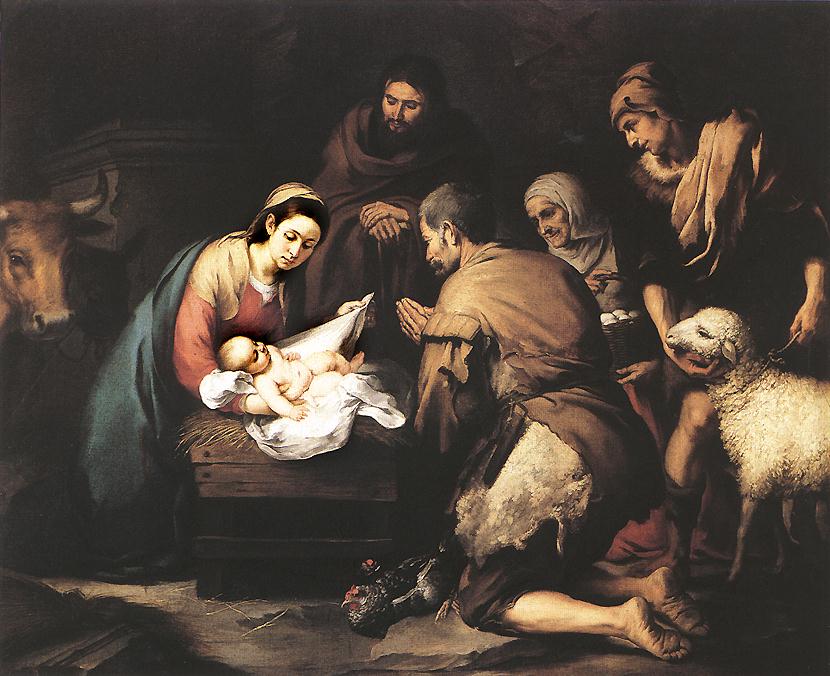
BartolomeEstebanMurilloAdorationShepherds