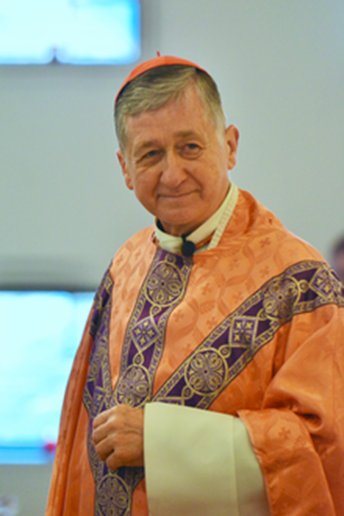
Kareem Irfan introduces Ofram. Chicago Cardinal Blase J. Cupich, provided opening remarks during the Third Meeting of the National Muslim and Catholic Dialogue at University of St. Mary of the Lake/Mundelein Seminary, on March 7. Dr. Rita George-Tvrtkovic, associate professor of theology at Benedictine University, and Dr. Irfan Omar, associate professor of theology at Marquette University, were the guest lecturers. This year’s topic was, “One God, One Humanity: Confronting Religious Prejudice. (Karen Callaway/Chicago Catholic)
After seven years as Co-Chair, Cardinal Cupich will hand over his role to Bishop Elias Lorenzo, OSB, of Newark, NJ, beginning in 2025.
Participants reviewed key passages from Pope Francis’ Encyclical FRATELLI TUTTI (On Fraternity and Social Friendship) published 3 October 2020 Fratelli tutti (3 October 2020) | Francis and LESSONS FROM Beiuzzamon Said Nursi’s TREATISE ON BROTHERHOOD
This is a link to PhD summary and assessment of Nursi’s Treatise on Brotherhood: 2e.xps (Original text is difficult to find online.)
Consensus from dialogue with both documents:
Cognizant of the conflicts of the past and aware of their historical contexts, we ask God to help us see ourselves anew in the present time.
The necessity of individual and mutual prayer asking God to help us respond to evil with good (Nursi’s Third Principle of the Fourth Aspect of Brotherhood); patience and understanding to illuminate the evildoers suffering as in Luke’s Gospel Sermon on the Plain Chapter 6 vs 27 ff “Love your enemies, do good to those who hate you . . .”
Quotes from the Qur’an include:
Q 25:46 God created diversity “so that you know one another”
Q 49:10 “Indeed, the believers are brothers” (i.e., all believers in God)
Participant Jordan Denari Duffner PhD is finalizing a brochure on ISLAMAPHOBIA in the USA for distribution to Catholic Churches. Professor Duffner, a Dialogue writes a blog and conducts podcasts. Go to: Jordan Denari Duffner
FUTURE GOALS FOR THE DIALOGUE:
Collaborate on promoting Educational Resources for Catholics re. the Palestinian-Israeli Conflict
Advance Humanitarian Efforts to the suffering in Gaza through Catholic Relief Services and promote the International Peace Efforts supported by both Jews and Muslims (E.g., I was recently acquainted with the excellent Rossing Center for Education and Dialogue in Jerusalem, Israel)
(Note: this article will appear in my Ecumenical and Multi-Faith Relations Office TOGETHER IN HOPE Newsletter for WINTER 2024-2025)
Guests listen attentively to speakers while under a stunning white and gold Lotus ceiling with the Sun shining its blessings on the event from the windows above.
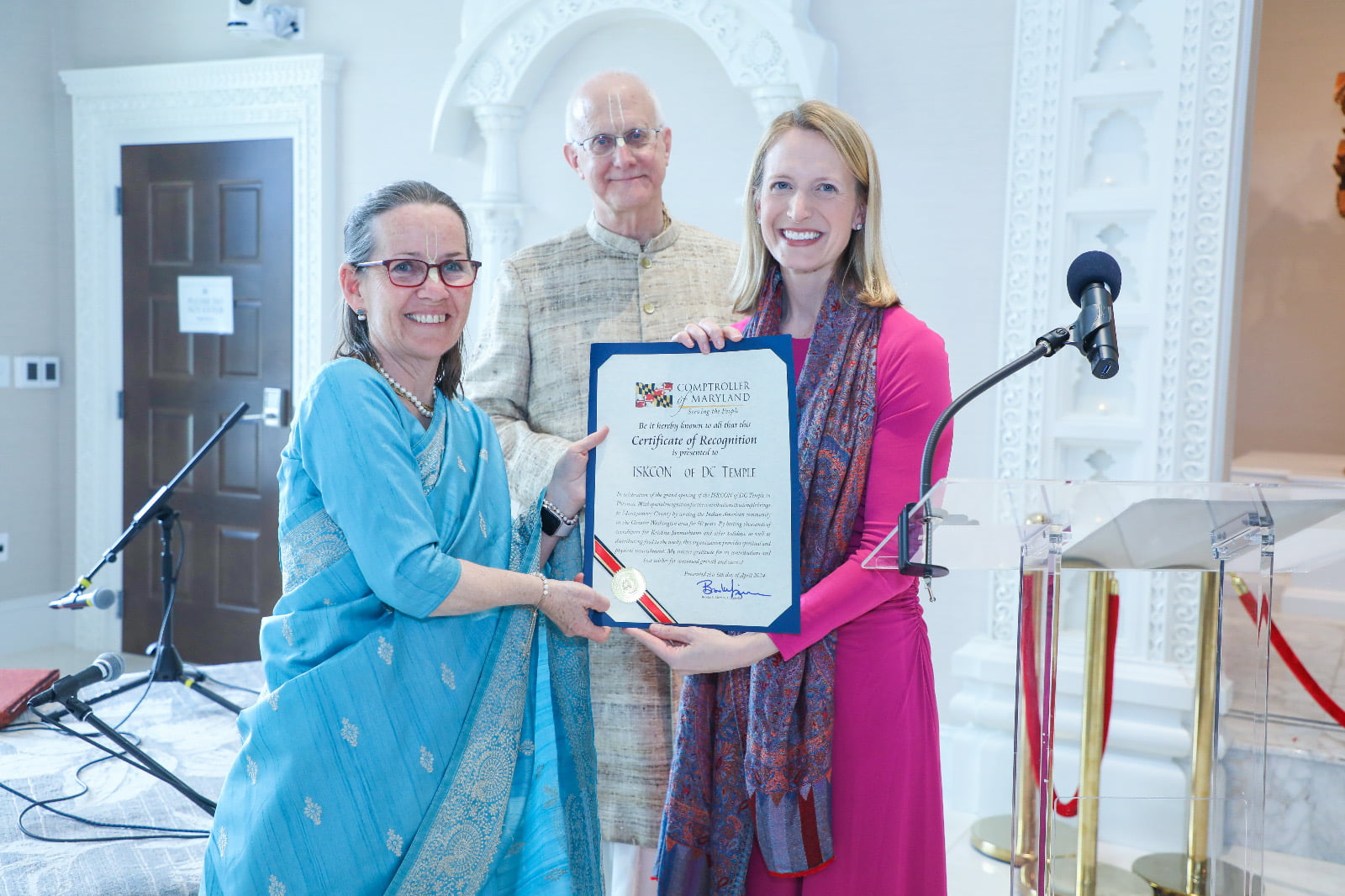
(L-R) Ananda Vrindavan Dasi and Director Anuttama Dasa accept recognition from Brooke E. Lierman, Comptroller of the State of Maryland.
As a participant in the Annual Vaishnava Christian Dialogue, I was blessed to attend the dedication of a new Hindu Temple and subsequent Dialogue LOVING YOUR ENEMY, convening on the weekend of April 12th through 14th 2024. The article includes my notes on presentations by Professors Patrick Beldio (Catholic), a scholar of comparative religion and theology with a focus on Hindu-Christian studies, and Vaishnava – Madana-Gopala Dasa (Mehul Barot), a Hindu and Kenya native, who serves as the North American Co-Director of ISKCON Communications, focusing on Hindu and media relations.
LOVING YOUR ENEMY – Hindu and Christian Perspectives
Our Dialogue began with two excellent, well-thought-out presentations by Hindu scholar Madana-gopala Dasa (Mehul Barot) and Catholic professor Patrick BelDio. Both asserted the centrality of love for all human beings and all of Creation. All love must be grounded in Love for God as each tradition dictates. Madan-goplas reasserted Vaishanava’s MONOTHEISM, insisting that the various gods, goddesses, and saints, incarnations, or manifestations of THE ONE. [1] In addition, it is important to note that Vaishnava is the dominant form of Hinduism throughout the world.
Patrick Beldio, a Catholic who interweaves his faith with comparable Hindu spirituality, presented Jesus’ statements in the Gospels, e.g.
“Love your Enemies, Do good to those who hurt you, Bless those who curse you, Pray for those who mistreat You”)[2]
He then offered an overview of Church History noting the contradictory behavior of the Church in the World.
Interestingly, while illuminating steps we can take toward loving our enemies, both men referenced the practical needs of self-defense and fighting against an adversary when necessary. With a brief summary of Church History, Professor Beldio asserted his preference for sustaining the “JUST WAR THEORY” — first articulated by Saints Augustine of Hippo (354-430) and later by Saint Thomas Aquinas (1225-1274) among others. However, all of the writings Beldio cited emphasized war as a “last resort” –after conflicting parties exhausted all efforts toward peaceful settlements.
Professor Dasa noted the foundational Hindu text Bhagavad Gita which, while emphasizing LOVE ABOVE ALL THINGS, allowed for warfare when the oppressor was inordinate in causing suffering. In fact, the spiritual epic “Gita” for short, opens with the assembling of armies! But a subsequent dialogue ensues between Patha (Arjuna), son of Pandu, and Lord Krishna, provides context:
Arjuna said:
“How shall I
In battle against
Bhishma and Drona,
O Madhusudana,
Fight back with arrows
against those who
are worthy of respect,
O Slayer of the Enemy? “
After a long discourse comprising several chapters, “The Beloved Lord” said:
The Dialogue participants included 15 Christians comprising Roman Catholics, Presbyterian, Non-denominational, and unaffiliated Christians and 11 Vaishnava , including many who practice Bakhti Yoga. Our conversations morphed into a discussions on the concept of Justice, Fairness, and heavenly realities that alone can bring about a perfect reconciliation among peoples. Each tradition made use of the term “GRACE” and/or its equivalents, emphasizing our mutual belief that no good whatsoever comes about without help from God.
Debate ensued as to whether there could be any “just war,” as per recent written letters, reflections, and homilies from Popes John Paul II to Francis. Roman Catholic participants affirmed that our tradition is advancing the consensus that, with all the advanced weaponry and war machinery sequestered in international governments’ arsenals, there can be no “just war.” The devastations that ensue, even at the smallest levels, bring pain and suffering beyond humanity’s ability to heal in the present context or in the future.
Mercy and compassion are Hindu hallmarks that empower the love of enemies. With the help of Krishna, the devout Hindu strives to be ever-loving, even amid conflicts. Nevertheless, one must confront evil and wrongdoing and be ready to act against it–even if violence ensues.
Referencing both ARJUNA in the Bhagavad Gita and Jesus in the Gospels, Dasa reiterated “Love does not exclude violence in some contexts.” He cited this quote from the Bhagavad-Gita 2: 29-39; 36b, “The embodied, eternally indestructible, dwells within the body of everyone, O Bharata. Therefore, you should not grieve for any living being. . .Therefore, rise up, O Kaunteya, acting with firm resolve for battle. Acting the same in happiness and suffering, gain and loss, victory, and defeat, Then prepare for battle—thus you shall not suffer misfortune.” (Graham M. Schweig translation. See footnotes.)
In support of his position, Dasa quoted Jesus in Matthew 10 vs. 34, interpreting it as an acceptance of sin and conflict even in a Christian context: “34 “Do not suppose that I have come to bring peace to the earth. I did not come to bring peace, but a sword. 35 For I have come to turn “‘a man against his father, a daughter against her mother, a daughter-in-law against her mother-in-law—36 a man’s enemies will be the members of his own household.’[c]
Patrick BelDio summarized his emphasis on Christian perspectives.
Violence is the tragic consequence of sin, which is inevitable in this world. We can only conquer our violent tendencies with God’s grace which, tragically, many reject. Furthermore, situations require self-defense, and even aggression may be justified to stop a greater evil. He also cited. Matthew’s Gospel 10: 34 -36. Jesus: A Cause of Division, while clarifying that the passage does not justify violence (including emotional violence, particularly within families) but recognizes its reality in our fallen state of sin. . 34 “Do not think that I have come to bring peace upon the earth. I have come to bring not peace but the sword. 35 For I have come to set a man ‘against his father, a daughter against her mother, and a daughter-in-law against her mother-in-law; 36and one’s enemies will be those of his household.’ (New American Bible, Revised Edition translation)
The ensuing dialogue acknowledged disagreements in the interpretations of texts cited, at the same time, affirmed a consensus:
It is necessary that people of faith continually discern our own culpability in contributing to seeds of hatred and acknowledge our inward motivations toward violence. Faith requires a personal confession that our attempts at objectivity are forever flawed as all are enmeshed in any given problem and its context. Thorough evaluation of the causes of enmity must be embraced with honesty and humility –both virtues -and all the other virtues — are essential to bring the perpetuation of violence to an end.
Surrender to Grace is paramount and is the foundation of all virtues.
The role of Lament regarding the thoughts and feelings in our hearts and our own actions that have harmed others must be experienced as the first step toward “loving one’s enemies.” Self-scrutiny –seeing other persons, other nations, and their policies within the realm of our own personal, national, and international failings – is required to begin the process of seeing others as fallible human beings as ourselves, and thus capable of “being loved.” All paths to forgiveness, accountability, and reconciliation must be rooted in our common humanity.
“Restore. Repair. Recompense. Reparations” is a good mantra to embrace once people have resorted to violence. It evidences appropriate accountability.
From Pope Saint John Paul II: “There is no peace without justice, no justice without forgiveness.” [4]
[1]Vaishnavism – Wikipedia See also this summary from Microsoft Copilot: “Vaishnavism is one of the major traditions within Hinduism, devoted to the worship of Vishnu and his avatars, particularly Krishna and Rama.
In the context of monotheism, Vaishnavism can be seen as both monotheistic and monistic. Here is how:
Monotheism: Vaishnavites believe in a single, supreme God, Vishnu, who manifests in various forms and avatars. This belief aligns with the concept of monotheism, where there is one ultimate divine being.
Monism: While Vaishnavism recognizes the diversity of deities and their manifestations, it ultimately views them as different aspects of the one supreme reality. This aligns with monistic philosophies that see all diversity as ultimately rooted in a single, unified existence.”
(Note: this article will be the centerpiece of my Ecumenical and Multi-Faith Relations Office TOGETHER IN HOPE Newsletter for WINTER 2024-2025)
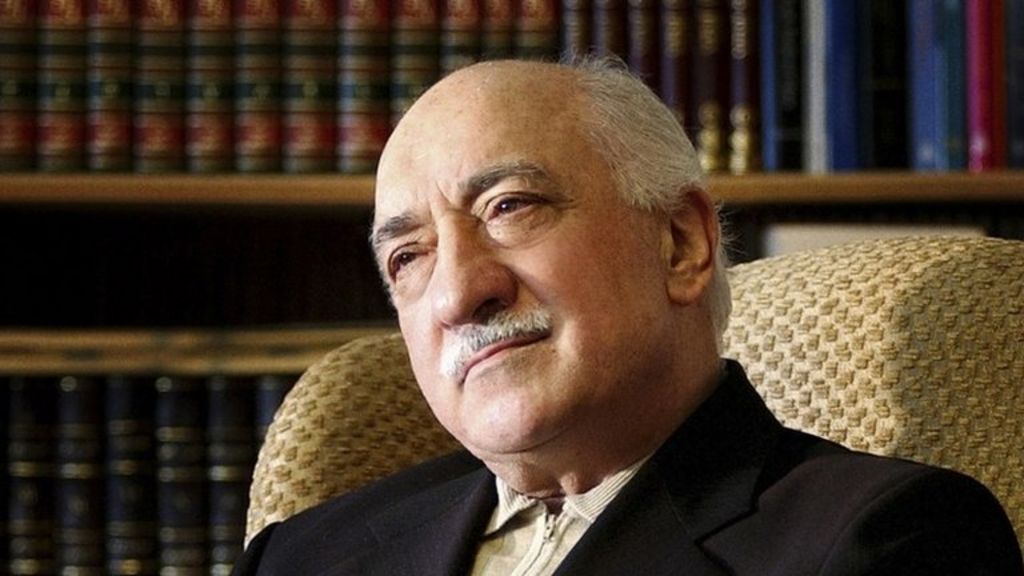
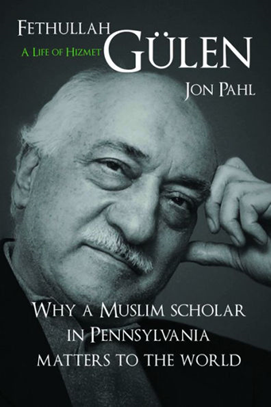
Professor Gulen was a devout Muslim Imam committed to Multi-Faith dialogue who fostered a broad education for Muslim youth –girls and boys–under the designation HIZMET (Arabic for “Service”). He began his work in “Türkiye” (natives prefer the pronunciation Tur-key-yeah, not the English “Turkey”) and through his advanced studies and lectures, he inspired the Hizmet movement, establishing schools and Multi-Faith organizations worldwide. Hizmet encourages ongoing conversations at the intersections of Theology and Science as it fosters comfortability in all pursuits of knowledge. Gulen was known for his deep spirituality highlighting Love as God’s essence and as God’s invitation to and for all peoples. His writings and lectures (over 60 published books) reflect his inspiration from the Sufi Tradition and the poetry of the 13th-century Islamic Mystic Rumi. He became an expert on Siad Nursi’s Risale- I Nur, an important work of early 20th Century Turkish thought. [1]
Founder of the Hizmet Educational System & Collaborative Service
After years of study from the early ages of childhood in the Qur’an, Western and Asian Wisdom Literature: History, Novels, and Philosophy, Fethullah Gulen founded Schools of Service (Hizmet) in his native Türkiye. He integrated the insights and strengths found in the various educational currents, encouraging educators to cultivate a “marriage of mind and heart,” an interdisciplinary amalgamation that invites students to acknowledge their spiritual selves and bring their insights and struggles into classes on every subject from math, science, literature, art, and music to Phys Ed!
Hizmet schools were flourishing throughout Türkiye until Recep Tayyip Erdoğan first became Prime Minister and subsequently the nation’s President. Before that, Gulen and Erdoğan had been friends and like-minded citizens,. That changed after Erdoğan’s political ambitions forged more traditional Islamic alliances critical of the progressive exchange of ideas. Gulen came to the United States seeking expert medical attention in 1999. Subsequently, Erdoğan’s growing authoritarian sensibilities and democratic backsliding motivated Gulen to remain in a self-imposed exile in Pennsylvania, where he lived, wrote, and lectured until his death on October 20th, 2024.
In 2016 Erdoğan made Hizmet his scapegoat for a military coup attempt to depose him. The accusations were ironic in light of Hikmet’s foundational peace objectives, yet Erdoğan labeled the movement “a terrorist organization” and “Enemy of the State,” imprisoning and exiling thousands of Hizmet professors, students, and sympathizers, seeking Gulen’s extradition from the US. Since then, our nation has welcomed many expatriates of Türkiye while Erdoğan continues to hold over twelve thousand Hizmet in Turkish prisons.[1] You can access more information on Erdoğan’s persecution of Hizmet here: Country policy and information note: Gülenist movement, Turkey, October 2023 (Accessible) – GOV.UK
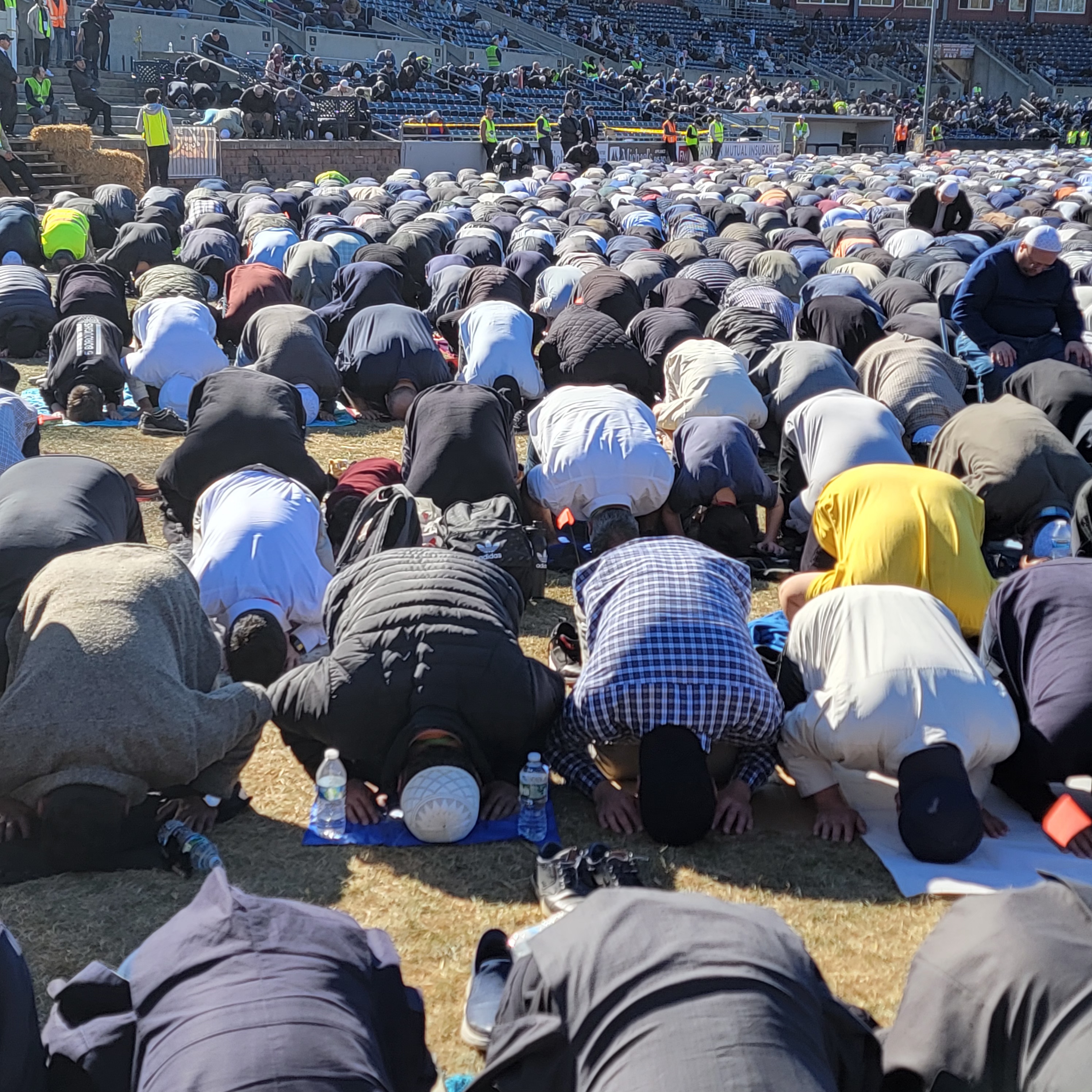
For the past two years I have interacted with members of Peace Islands of New York and New Jersey, two prominent Hizmet organizations. (See LEGACY section below for more information about Peace Islands.) Emre Celik, Director of Peace Islands New York, invited me to attend testimonies and eulogies honoring Fethullah Gulen in a stadium in Augusta NJ on October 24th. Later in the day, we proceeded to Gulen’s burial place near Bethlehem, PA. Although Islamic Tradition requires burials within 24 hours of a person’s death, Gulen’s family and Hizmet Directors postponed his funeral for three days to allow over a thousand international Hizmet educators and facilitators to travel from their homes to pray farewell and honor their mentor. It was inspiring to witness their steadfast belief in the promise of eternal life for Gulen and all people of goodwill.
Because of numerous, necessary security precautions, Peace Islands instructed me to drive from my rectory in New York City to a designated spot in New Jersey. From the parking lot, I then joined mourners on one of many buses taking us to Augusta. On the way I chatted with a woman educator from Texas who shared her story of exile from Türkiye, her reunification with her husband and children here (she fled first, alone, and unaccompanied), and how they were all adjusting to American life. Once we arrived at the outdoor Skyland Stadium and Entertainment Center, I was taken aback by the large crowd. With long lines of people waiting to get through security, I had the sense I was present at an important moment in history. I met many professors, scholars, and scientists — people from Germany, Brussels, Tanzania, Uganda, Australia, and Canada—along with hundreds of professionals, lay people, and their families from throughout the USA. Each in their own way spoke with reverence for Imam Gulen and how he filled their lives with hope, invigorated their faith, strengthened their quest for lifelong education, and motivated their purposeful collaborative friendships and service engagements with people of many faiths and denominations. I could not find an official tally, but estimates ranged from ten to twenty thousand people. An astounding witness to what these divided United States could cultivate in the here and now!
I appreciated the collegiality and compassion of the many sponsoring Hizmet communities who coordinated the memorial throughout the warm, sun-filled day. Humbled by the way they welcomed this Catholic priest with hugs and bows of respect, I readily returned their affection in kind. Peace Islands New York Director Emre Celik assigned me an attentive host and guide, Mr. Umit Gunebir, President of the Atlantic Institute in Georgia, USA, another Hizmet outreach. (See Atlantic Institute.) So considerate and kindhearted, Umit highlighted the respect and appreciation for another that is central to Hizmet philosophy and that was evident in so many of the interactions I observed.
Mehmet KilicMehmet Kilicand me. Mehmet is President of the Journalists and Writers Foundation, See: https://jwf.org A member of Peace Islands New York, a Hizmet outreach, Mr. Kilic is affiliated with the United Nations Multi-Faith division.
Above all, I was impressed by the sincerity and devotion apparent in all the men who filled the sports field (in Islam, men and women worship in separate groups), as the memorials in Arabic, Turkish, and English were interspersed with the compulsory prayers designated for five specific times throughout each day to keep believers ever-mindful of God.
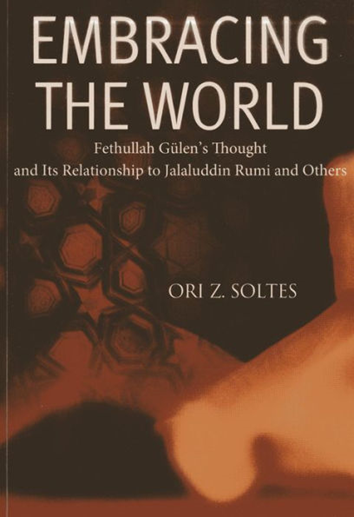
In addition to the United States, Hizmet schools and initiatives have found welcome home in Canada, Africa, Australia, and Asia. Gulen’s advocates include intellectuals from both Christian (Catholic and Protestant) and Jewish communities, including two noted scholars—Jon Pahl Ph.D. (United Lutheran Seminary) and Ori Soltes Ph. D (Georgetown University). Gulen’s lectures and published writings have inspired dozens of Multi-Faith International initiatives cultivating Multi-Faith friendships and cooperative service projects through organizations such as these:
The Atlantic Institute – fostering a global community through education, interfaith dialogue, and meaningful social experiences. Atlantic Institute.
Although sometimes referred to as “The Gulen Movement,” evolving a progressive and broad-minded Islam, the professor urged his students to claim the term HIZMET in all their undertakings, preferring to be one professor among many. See this article by Jesuit Father Thomas Michel (unfortunately titled “Gulen Movement”) here: Hizmet Schools: A new pedagogy
No organization is without controversy. Because of the political dynamics with Türkiye, there are complexities and critical perspectives regarding Gulen and the Hizmet schools. For further investigation, see:
Dr. Ori Z. Soltes is Goldman Professorial Lecturer in Theology and Fine Arts at Georgetown University. He is the former director and curator of the B’nai B’rith Klutznick National Jewish Museum in Washington, DC. He earned his B.A. in Philosophy from Haverford College, his M.A. in Classics from Princeton, and his Ph.D. in Interdisciplinary Studies from Union Institute and University.
MORE ABOUT ORI Z. SOLTES PH.D.
Professor Soltes is the author of more than 130 articles, exhibition catalogues, essays, and books and is the writer, director, and narrator of more than 30 documentary videos. Among his most recent books are Fixing the World: Jewish American Painters in the Twentieth Century; Our Sacred Signs: How Christian, Jewish and Muslim Art Draw from the Same Source; and The Ashen Rainbow: Essays on the Arts and the Holocaust. Professor Soltes has taught and lectured in more than 20 universities and museums nationally on subjects ranging from Symbols of Faith: Art as an Instrument of Addressing God to The Body in Ancient Art. Throughout the United States and overseas, he has guest-curated exhibitions that have focused on diverse aspects of Western art throughout the ages and art from across the world.
The following comes from a short story by Anton Chekhov: There once was a wealthy Russian Matron– demanding, impatient, dismissive to the point of cruelty in the way she treated her maid servant. One day, in a particularly angry and condescending mood, the matron snaps at the young woman as usual. This time, however, she focuses on the girl’s eyes and realizes for the first time the deep humility–the depth of the servant’s unconditional care for the older woman. The matron bursts into to tears. She cries out, “How is it you care for me? I have not shown you the slightest kindness. How is it that you take my abuse time and time again? I am undone!” The matron sits at her desk and sobs uncontrollably, waving the maid away. Chekhov leaves us there. What will happen next? Will any good come of it this encounter or will all go back to the way things were?
Human Nature is filled with contradictions. Often, we are BLIND TO GRACE. Yes, even we disciples get caught up in our own drives, our own priorities, our own needs. We take others for granted. Tempted to believe we are above the common fray; we think we are not like others. We fancy ourselves “superior specimens.” In frivolous moments it may be fun to think that even God could learn a thing or two from us! But should we fully believe that, should we think that our achievements are all that matter in this world, or that beyond our personal comfort, nothing matters, nothing is worth striving for– we are in a bad state. It is called SIN. We are prone to it. It enervates us, makes us fatigued. We live for ourselves without a quest, a greater good, a greater Truth to inspire us. This is why the Mass begins with the Confiteor, or Penitential Rite. This is why the phrase “have mercy on us” is included in the Gloria we pronounce every Sunday. Our souls cannot move into Sacred Space without self-scrutiny for the love of God. And it is because we are loved by God that we trust our failings are forgiven and hope becomes eternal.
Sadly, there are those among us who adopt a different worldview. Oozing arrogance, they stain their souls with overindulgence. They take their delusions of grandeur all too seriously, regarding no one worthy of their time beyond those who serve their purposes and priorities. Often bitter and vengeful, they succumb to the deadliest of the Seven Deadly Sins: Pride beyond the need for relationships, beyond self-scrutiny, beyond the give and take of forgiveness, beyond God.
In today’s Gospel, Jesus stands before such a person. His name is Pilate. Notice the extraordinary contrast between one man and the other. Pilate is cynical. Pilate is bored and bothered. Pilate believes he can afford to be thus, because, after all, he is Caesar’s regent. He has legions of armies behind him.
Jesus on the other hand stands alone, seemingly powerless before this earthly judge. Yet take note of Jesus’ confidence, his self-awareness, his courage to speak TRUTH to Pilate who cannot imagine TRUTH to be POWER. The Truth that Jesus speaks: Life is rooted in the Absolute Goodness of God. Only belief in God, God’s patience, God’s mercy, God’s Justice, and God’s care for creation bring fullness of life. God’s Holy Spirit empowers courage in us to wage against the falsehoods, the evils of this world. Jesus embodies those Truths and invites us to incarnate them, too. Trust in ourselves and in our illusions, well, then our potential for building strong character, our strivings for heaven are lost. Trust in God, in Christ, and the Gifts of the Holy Spirit, then Prudence, Temperance, Justice, and Courage deliver us into the Kingdom Jesus inaugurated. A kingdom where Faith, Hope, and Love reign eternally.
Pilate does not see this. He does not see Jesus as Jesus is meant to be seen. If he did, he might have noticed Jesus’ compassion and care—yes, care, even for Pilate. He would have seen himself as a lost sheep, recognize his arrogance as his false self — a camouflage for his inner fear and confusion, compelling him to avoid the good, the right, the virtuous and take the easy way out –giving in the manic cries of a crowd who could not see what they were becoming, the temptations to which they succumbed. Alas, neither they nor Pilate took the time for self-scrutiny, for he became their spokesman in the way he scoffs Jesus. Jesus said, “Everyone who belongs to the truth listens to my voice.” Pilate’s cynical response: “What is truth?”
Happily, we are not celebrating Pilate today. We are worshiping Jesus as Christ and True King, the only TRUE Messiah. Jesus does not compromise eternal verities. Jesus abides in universal, absolute, and necessary Truths that alone offer human fulfillment. Jesus knows too well what Pilate represents–a world that sees no end but its own ends. A world that hides behind delusions of grandeur, manipulating Justice to its own ends.
Today we acknowledge, once again, Christ the King as the only one worthy of the title. We pray that in the presence of temptation, we will not forsake truth, even amid confrontation and conflict. BUT WE WILL FORSAKE EASY WAYS OUT OF DIFFICULT SITUATIONS. We pray to strengthen one another in building character– not compromising our true self – because we do not have to! Jesus is Christ, Lord, and Our God and He is here to help.
How can we make THANKSGIVING a truly prayerful AND joyful day for everyone? Here are suggestions — you cannot possibly observe them all! — but use them as a springboard for your own ideas. Choosing between these activities needs to be a prayerful experience, so allow some space for quiet time, placing all your anticipated guests in your heart and mind before you look through these selections. Pray with them and let your own spirit be inspired!
THE WEEK BEFORE THANKSGIVING
Invite your guests to reflect upon these Two Questions:
What is your best and worst memory of Thanksgiving?
How might you turn both experiences into a prayer for this year? Write your own prayer.
Invite your guests to write their answers on an index card or postcard (or in an email) for their own personal reflection as they anticipate Thanksgiving Day. And- IF THEY ARE COMFORTABLE DOING SO – have them bring their card or printed email to the dinner. Let your guests know that you will invite everyone to share what they wrote as people gather, partake in Hors D’oeuvres, and settle in for the day.
DINNER CONVERSATION option # 1. Throughout the meal, each person will be asked to take what they wrote as their BEST OF MEAL and answer one of the following:
FOR CHRISTIANS: How were these “Best of Thanksgiving Meals” like or unlike a Eucharist or Lord’s Supper?
FOR JEWS: How were these “Best of Thanksgiving Meals” like or unlike Passover or Sukkot meals?
FOR MUSLIMS: How were these “Best of Thanksgiving Meals” like or unlike Ramadan meal celebrations?
FOR SIKHS: How were these “Best of Thanksgiving Meals” like or unlike Langar?
FOR HINDUS: How were these “Best of Thanksgiving Meals” for Thanksgiving like or unlike ONAM?
FOR BUDDHISTS: How were these “Best of Thanksgiving Meals” like or unlike your New Year celebrations?
FOR SECULARISTS: What makes your “Best of Thanksgiving Meals” linger in your memory? What does it tell you about what you value?
After everyone has shared, ask “What insights might you have gained from listening to people’s answers?” At the end of the meal, invite Spontaneous Prayer or lead your guests in a Thanksgiving Prayer from your tradition.
2. DINNER CONVERSATION option # 2. Invite your guests to read (or listen to the YouTube audio of) Truman Capote’s poignant and humorous short story The Thanksgiving Visitor before Thanksgiving Day. Let them know you will be inviting them to share their thoughts and feelings about this story throughout dinner. The story takes place in the past, but the relationship dynamics are perennial. Truman Capote reads “The Thanksgiving Visitor” on YouTube:
Make this an AFTER-DINNER ACTIVITY: Gather your guests to read or listen to The Thanksgiving Visitor – or any short story or children’s book–and discuss it. For Children’s Books, see The Best Thanksgiving Books to Read Aloud – Bookshop.org
3. OPTIONAL CHARITABLE COMPONENT TO THANKSGIVING DAY:INVITE each guest to BRING A SINGLE $ 1. BILL to participate in a PLEASE & THANK YOU GAME. Designate a charity and let them know what the dollars are for in advance. OR before dinner begins, have people choose the charity among three or four (no more than 4) you suggest. (E.G. A local Food Pantry, UNICEF, Habitat for Humanity – nothing partisan or controversial.) Have extra $1. bills around for those who forget to bring any. From the beginning of the Meal to its conclusion, should anyone forget to say “Please” or “Thank You,” (i.e., “Please pass the potatoes” or “thank you for pouring my drink”), he or she gets a WARNING. The SECOND TIME he or she must surrender their dollar into a basket for charity. At the end of the day, people may contribute additional $ if they wish.
4. Invite your guests to memorizeOVER THE RIVER & THROUGH THE WOODS by Lydia Maria Child in preparation for Thanksgiving and let them know you will have a contest as to who can recite (OR SING) the first three verses by heart. People can access the poem online at Over the River and Through the Wood – Wikipedia (or get the Book out from their library, or purchase it). If they prefer, they can memorize the much shorter poem THE MIST AND ALL by DIXIE WILLSON – Poetry Explorer – Your Free Poetry Website for Classic and Contemporary Poetry OR any other Autumn / Thanksgiving Poem they would like to share. People can recite their poem during dessert or help each other with the verses throughout CLEAN UP.
6. Prepare a Card Table with Index Cards & pens or pencils, a Small Basket or Shoebox and a poster or placard on which you have written these instructions:
Welcome! Take a card and write your response to ONE of the following questions. Do NOT print your name on the card as guests will need to guess “who wrote what” later today.
— “What experience of the past year do I treasure most?”
— “What gift that I received this year (no matter the occasion) continue to bring me enjoyment?”
Place these “Treasured Gift” papers in a small basket or shoebox and place it on or near the dining table. During the first course, invite someone to pick an index card at random from the basket and read it aloud. All the guests try to guess the identity of the author.
THE DAY BEFORE THANKSGIVING
• Set DVR to pre-record Thanksgiving Day parade(s) and Football Games; pre-record or purchase/rent CHARLIE BROWN THANKSGIVING or other cartoons. People can watch them during breaks or after dinner and clean-up is over.
Get Access to Music Ready via CD, Spotify, Pandora, YouTube (See item IX below)
If you chose to sponsor the Please and Thank You Game Charity Game, have extra $1. bills handy for those who forgot to bring any.
PRINTOUT A FEELING CHART FOR EACH GUEST. You can distribute copies to everyone as they sit at the table for your first course as a way to PREPARE for your PRAYER. The prayer will begin by acknowledging how everyone at your table is feeling –elated, sorrowful, etc. –an essential way to honor people and emphasize your care for them and invite them to ponder the love of a caring God. See THANKSGIVING DAY Item # 2 BELOW for the “how” and “why” of this Feeling-centered exercise.
A. If you have chosen to engage in “The Treasured Gift” game– Direct your guests to the CARD TABLE. If you did not choose to have people write their “Best” and “Worst” Thanksgiving Memories and Prayer in advance, you could have them write them out now and follow the directions in DINNER CONVERSATIN # 1 above.
B. If you did not choose to have people write their “Best” and “Worst” Thanksgiving Memories and Prayer in advance, you could have them write them out now and follow the directions in DINNER CONVERSATIN # 1 above.
2. TRADITIONAL GRACE “PLUS” – The “+” includes Faith Sharing before the meal. Begin by distributing copies of the Feeling Chart to your guests as they are seated for dinner.
INSTRUCTIONS FOR ALL: EXPLAIN that the purpose in asking people to claim a feeling–and to name it for others to hear–provides us with a way to express our care for one another and respect our differences through attentive listening. The emphasis is on listening so we may address what we hear by way of acknowledging our feelings in our Prayer before our Meal. We ask that no one comment on any one person’s feeling words for there are no right or wrong feelings. “We feel what we feel no matter what the holiday may or may not mean to us.” Feel free to “pass” if you are not comfortable naming what you feel, but we hope you will.
Using the Chart as a guide, each guest may identify one or two “Feeling Words” (“Happy,” “Sad,” “Thankful,” “Frustrated,” etc.). We ask that NO ONE EXPLAIN their choice of word(s). That qualification is VERY IMPORTANT or the prayer before the meal will become unruly. Ask that NO ONE COMMENT on another’s feelings. Should someone start to explain, tell them they can share later, but “please only one or two words” After all of your guests have identified their feelings, pray the following (or use these ideas to create a prayer of your own):
“Dear God, HERE WE ARE! We are family and friends — and we bring all these feelings to you on this Thanksgiving Day. Faith attests that You accept us as we are. Help us open a place for you in our hearts, grant us peace and serenity, help us to identify people, places, and things for which we are grateful. Help us to make the most of this day, this meal, and our time together. Give us the grace to be kind, to be patient, and to affirm the best of what we know and see in one another. We know that Affirmation is the best way to cultivate Gratitude, and we hope that by the end of this day of National Thanksgiving, we may have more ways to affirm and bless one another and sing your praises.”
Then invite everyone to join in your family’s traditional Grace before Meals, OR if your company is of mixed religions, invite each to say his or her traditional grace in addition to your traditional one, OR you could also try this:
“Blessed are YOU, Source of Life, you are known by so many names, help us to experience GRATITUDE, for gratefulness nurtures mutual affection and places us on the path of peace. Bless our Meal and our Conversation. Amen.”
3. FIRST COURSE ACTIVITY (Soup/Salad/Antipasto): Treasured Gifts: During the first course, invite someone to pick an index card at random from the basket and read it aloud. All the guests try to guess the identity of the author. Once identified, invite the author to share why he or she remains thankful for this gift.
4. DURING THE MAIN MEAL: Invite each Guest to share his or her memories of the best Thanksgiving OR ANY SPECIAL MEAL that they have ever experienced and why it is an important memory for him or her. Use the Faith options in Part 1 “The Week Before Thanksgiving” (How this memory corresponds to a religious ritual or occasion) for additional points to share.
5. AFTER THE MAIN MEAL PRAYER: Post-Meal Prayers have fallen out of fashion. But since Thanksgiving is a Day of Gratitude and therefore a Day of Prayer, schedule a break BEFORE DESSERT (highly recommended), and before your guests leave the table, invite them to share spontaneous prayers for anyone or anything that concerns them. If you wish you could close with Psalm 121.
6. TAKE A BREAK BEFORE DESSERT and invite your guests to engage in some Physical Activity such as a walk outdoors or help in the kitchen, clearing the table, or playing Musical Chairs in the Living Room. MEANWHILE, guests should review their poem (Item # 6 noted above) and be ready to recite it at dessert.
7. DURING DESERT: POEM RECITATIONS.
8. THE FINAL CLEAN UP – HAVE EVERYONE JOIN IN. OR, if there are space limitations in the kitchen, direct those who cannot help to begin Social Activities.
9. SOCIAL TIME:
Community Games to Have on Hand: Charades, Pictionary, Balderdash
Dancing: Access the Music you have chosen via CD, Spotify, Pandora, YouTube
Old Fashioned WALTZ: I recommend “O Mio Babbino Caro” sung by Kiri Takanawa (CD: Kiri Te Kanawa Sings Verdi & Puccini) or on YouTube https://www.youtube.com/watch?v=ZRuYQ9KRJms
MAKE UP DANCES to selections from Charlie Brown Thanksgiving Full Soundtrack (some are downright silly!) available on YouTube here: https://www.youtube.com/watch?v=nsZBEng7aJM
10. LINGERING TIME: Now people can watch the Football replays or evening games, play board games, watch Charlie Brown and other cartoons.
11. FAREWELLS As each person prepares to leave, ask if they would like a final Thanksgiving Blessing. If yes, the Hosts may place their hands on each guest’s head or shoulders and pray the PRIESTLY BLESSING from the Book of Numbers, Chapter 6: 24-26: “The Lord bless you and keep you! The Lord let his face shine upon you and be gracious to you! The Lord look upon you kindly and give you peace! “Conclude with “Safe home! Godspeed! God bless!”
12. FOOTBALL FANS OPTION: If your guest list comprises a majority of Football fans, CONSIDER planning your meal and activities around them. Here is the Game Schedule for this year:
Recall the fable of Chicken Little: The Sky is Falling! And a parade of gullible animals ensues, following the little chick to –well, they do not know where they are going, they just keep moving and warning whoever will listen. At last, the larger beasts, acting according to their natures, pounce! They devour the smaller mammals and go about their lives. Perhaps that was their original intent when they joined in the procession. People, like fellow mammals, take advantage of anxiety and fear in others. The way of the world.
The prophet Daniel warns of times of great distress, and people fleeing everywhere, but not as fearmonger, but as a realist describing worldly realities. He ends his prophecy with Good News – many will ‘awake’ and “live forever and shine like stars in the firmament.”
Scholars tell us that this was the first clear biblical reference to resurrection, judgement, and afterlife in the Bible, written down in about 167 B.C.E. reflecting the growing awareness inherent in Judaism (and many other world religions) hundreds of years prior. Further clarification arrived through the Book of Wisdom (100 B.C.E.) for Pharisaic movement had already confirmed resurrection and eternal life as an essential tenet of faith.
So often people ask, “Why did the Christ chose to enter human history when he did?” Our explanation must include the longings of humanity for belief in an eternal soul for all –not just Kings and Pharoahs and mighty conquerors—was ready for the Christ to reveal, to confirm, to incarnate life, death, and resurrection as the everlasting, universal, foundational pattern of all Creation.
We must never take for granted our belief that heaven is our ultimate goal. Jesus’ resurrection remains the cornerstone of faith, just as it was for the earliest disciples. Christianity is not just Commandments and virtuous deeds, but participation in LOVE that is ETERNAL. Nothing is wasted. Goodness grows beyond the grave. Please do not rationalize our faith in Resurrection. It is not a mere metaphor; it is not only a comforting thought. It is the foundation of the world, Creation’s ultimate purpose.
Now, of course, DOUBT is part of a living faith. We wrestle with it continually, especially when conflicting thoughts and feelings wreak havoc within us, with others, with the world as it is. But hold on! Jesus promises to arrive in the midst of them—and arrive He does! He does not take advantage of us like some beast of prey. No. He delivers us from evil, comfort us in our distress—if we let Him, and He reminds us that, although we know NOT the ultimate day or hour, Heaven Awaits.
The Church confirms Jesus’ presence among us in every Sacrament we celebrate. The ‘sacred is manifested’ in our churches to remind us that grace nourishes us in faith, hope, and love in every situation and circumstance. We must allow Jesus’ Eucharistic Arrival today to intensify our faith, deepen our hope, and deliver us from the turmoil of the world. We have the gifts we need to address the wrongs of the age –and yes, they are many, but Christ, the Eternal Sacrament, confirms faith in Heaven and a Communion of Saints accessible to us here, now, and always.
We need not be afraid. Emmanuel has come and will come again, again, and again. Come, Lord Jesus, today!
The perennial question “How can we still believe in God with all the sin and evil in evidence in the world?” Comes in many forms and in many particular contexts, all interrelated. The question is often phrased specifically in terms of the sins of Christians as sufficient reason to abandon faith. To me as a Catholic priest, the question is contextualized in whether or not the Catholic Church can be an authentic way to God because of the continual exposing of its sins of child abuse and the removal of the statutes of limitations that bring the egregious sins of the past ever mindful to the present. There is no perfect answer, but this is the best I can do:
“Faith requires us to always look beyond the realities of sin and evil to a much bigger picture. Catholic priests’ sins and sicknesses are worth crying over and indeed a deep wound. Most are now dead, and others have been expelled from the priesthood. Victims have been offered counseling and monetary recompense, inadequate though that may be because of the depth of the betrayal. The “bigger picture” invites us to acknowledge the vastness of sin in every aspect of life and be open to look to those who offer positive witness to hope, humility, and kindness. The Cross of Jesus will always expose sin as it did 2,000 years ago, and faith in Christ invites us to be part of healing its wounds especially when we are tempted to run away as the Apostles ran in horror and disgust only to return because there was nowhere else to turn to live in Hope except in Resurrection. In a strange paradoxical way, failures and sin can motivate greater attention to God and our need for a Church as they can for condemnation of faith. Perhaps staying within a wounded institution helps strengthen our attention to God and all the world” ‘s needs for transformation, healing, and spiritual growth. Some find comfort in other denominations, others in different faith options or humanistic philosophies. Each of us must decide what path we can take or tolerate that helps us hold on to hope and love. Where do we find a place, a people, an institution that will accept us with our own failings and mistakes without denying us encouragement to enhance our better selves and inviting us to a deeper relationship with a merciful God?”
We often are intimidated sharing our faith and values with others in today’s climate of polarization, vitriol, war and violence. The Jesuits named below entered just such an environment in what is now Eastern Canada and Albany New York from 1642 through 1649.
The rivalry between the Iroquois and the Huron tribes, also known as the
Beaver Wars, was a series of conflicts fought intermittently during the 17th century.
The Iraquois Confederacy, consisting of the Mohawk, Seneca, Onondaga, Cayga, and Oneida tribes, sought to dominate the fur trade routes controlled by Huron Wendat Confederacy, allied with the French, controlled these lucrative trade routes. The Martyrs remembered today worked among Hurons. The Beaver Wars were not just about trade but also
Cultural Differences:
Political Alliances:
Fear of Colonization:
Resistance to Change:
Violence and Retaliation:
It is helpful to remember the priests were not killed only because of their religion but because of the realities of fears and conflicts that existed through all the ages, down to this day. The world’s ways wag on, but faith, hope, and love will endure as we make these virtues the heart of our lives.
The first of the Jesuit missionaries to be martyred was René Goupil in 1642. He was tomahawked for having made the sign of the cross on the brow of some children.
October 18, 1646 Father Jogues was tomahawked and beheaded. Jean de Lalande was killed the next day at Ossernenon, a village near Albany, New York.
Father Anthony Daniel, working among Hurons was killed by Iroquois on July 4, 1648. His body was thrown into his chapel, which was set on fire.
Jean de Brébeuf composed catechisms and a dictionary in Huron, and saw 7,000 converted before his death in 1649. He authored the pensive HURON CAROL. Having been captured by the Iroquois, Father Brébeuf died after four hours of extreme torture.
Father Charles Garnier was shot to death in 1649 as he baptized children and catechumens during an Iroquois attack.
Father Noel Chabanel also was killed in 1649.
Gabriel Lalemant had taken a fourth vow—to sacrifice his life for the Native Americans. He was horribly tortured to death along with Father Brébeuf.
There are two Churches honoring the martyrs. One is in Auriesville, New York and the other is The Martyrs’ Shrine is located in Midland, Ontario, near the site of their missionary work among the Huron (Wendat) people.
I was giving a retreat. I was preaching on this passage and linking it to Luke’s version of the Beatitudes in which for every blessing there is a woe – “Blessed are the poor for the kingdom of God is theirs. Woe to you who are rich, you have received your consolation.”
A man in the congregation stood up. “I take offense to what you just read. I am sick and tired of the Church preaching against the rich. We do a great deal for our churches. It is because of us you have a new roof on this building. Because of us you priests have food on the table! Where would Catholic Charities be without us?”
I said, “I don’t think this Gospel is condemning your generosity, Sir. Why don’t we explore the passage and see if we can find some common ground.”
He replied, “Dear God, can’t you talk about something else? ” He sat down.
“What is at the heart of the phrase “give all to the poor?” anyway? No one can give all to the poor without becoming destitute. Is Jesus’ phrase “nothing is impossible for God” about making us all destitute? Perhaps the man was right to be offended!
Could it be that “Giving up everything” is about centering ourselves in God – thinking of God in every choice we make, every word we speak?
Do we think of God after a harmonious event?
Do we think of God when we find ourselves in love?
Do we recognize that that woman or man or spouse, or friend who touches our hearts so deeply could be God’s gift to us?
Do we think of God when we get an “A” on a test, celebrate a birthday, or will we, think of God should the Yankees win the world series?
Ultimately, Providence is at work. Our lives are not our own. That is True Wisdom.
The GOOD NEWS TODAY IS THAT WE ALL CAN PARTICIPATE IN THE KINGDOM OF GOD no matter our income, our social contacts, our achievements. When our riches, our accomplishments, root us in a mindset that they come from God –or God’s good purposes– ALL IS WELL, and the Kingdom of God is at hand. Nevertheless, riches are but the crust on a loaf of bread. We love the crust – crispy, tasty, buttery. The heart of the bread, however — what Jesus calls the kingdom of God, the bread of life — finds itself in the essence, the nutritive elements in the bread: the yeast, the risen dough. That’s what is important. It is not the crust, but the whole loaf that represents Kingdom that is bread for all the faithful. Best of all, bread is more spiritually nutritious when it is broken and shared.
The man stood up again. He said: “I don’t know why you have to talk about this,” he said. “ Show some gratitude for the wealthy or leave us alone.”
I said, “I am sorry, sir. I thought my reflection would put us on the same page.”
He said, “No, father, we are not on the same page.” Suddenly the congregation, called out in one voice: “Turn the page! Turn the page! Turn the page!”
I would like to leave us with this: We have no idea what happened to the rich young man in the Gospel after he left Jesus’ company. We must take note, however, that although he was wealthy, he was not content, and he WAS asking questions. What if he had stood his ground and said to Jesus, “Explain yourself.” Alas, he did not.
This Scripture reminds us that there is a time for everything under the sun. Maybe the young man in the Gospel just wasn’t ready to go further. The man at my retreat, at least, felt comfortable enough to voice his objections. Who knows what life may have had in store for either one of those rich men? Who knows what questions will arise in the hearts and minds of anyone as we go on our way?
I invite us today to TRUST IN GOD’S TIMING. Trust that today we are hearing what we might need to hear. But, if we are not “hearing what we need to hear,” just knowing that we’re not ready to engage in what we hear- having that kind of self-knowledge – might just be enough to be good for today. What is most important, however, is that we keep coming back. Keep asking, keep praying, keep pitting our answers against others to see what we come up with together. Keep the book open, without judging one other. It is vital that we honor the fact that we are all in different stage in our respective faith journeys. We turn the pages at our own pace, trusting that Jesus, God as a human person, is all in all. That’s true Faith. Who knows? Perhaps, someday, in some way, we may find ourselves all on the same page.
The Canticle of Saint Francis of Assis on his Feast Day 4 October
Today is the Commemoration of the life and witness of Saint Francis of Assisi – a patron and advocate for the Care of Creation in Roman Catholicism, Orthodox Christianity, the Anglican and Episcopal Communions, the Lutheran Church, and others. What better way to celebrate his day than by praying Francis’ beautiful Canticle Laudato Si (PRAISE BE YOU!) also known as The Canticle of Thanksgiving for Creation, and “Brother Sun, Sister Moon.”
English Translation:
Most High, all-powerful, good Lord, Yours are the praises, the glory, the honour, and all blessings.
To You alone, Most High, do they belong, and no man is worthy to mention Your name.
Be praised, my Lord, through all your creatures, especially Sir Brother Sun, who brings the day; and you give light through him. And he is beautiful and radiant in all his splendour! Of you, Most High, he bears the likeness.
Praised be You, my Lord, through Sister Moon and the stars, in heaven you formed them clear and precious and beautiful.
Praised be You, my Lord, through Brother Wind, and through the air, cloudy and serene, and every kind of weather through which you give sustenance to Your creatures.
Praised be You, my Lord, through Sister Water, which is very useful and humble and precious and chaste.
Praised be You, my Lord, through Brother Fire, through whom you light the night and he is beautiful and playful and robust and strong.
Praised be You, my Lord, through Sister Mother Earth, who sustains us and governs us and who produces varied fruits with coloured flowers and herbs.
Praised be You, my Lord, through those who give pardon for Your love, and bear infirmity and tribulation. Blessed are those who endure in peace for by You, Most High, they shall be crowned.
Praised be You, my Lord, through our Sister Bodily Death, from whom no living man can escape.
Woe to those who die in mortal sin. (Yet) Blessed are those who will find Your most holy will, for the second death shall do them no harm. Praise and bless my Lord, and give Him thanks and serve Him with great humility.
























 frjamesdiluzio