Kareem Irfan introduces Ofram. Chicago Cardinal Blase J. Cupich, provided opening remarks during the Third Meeting of the National Muslim and Catholic Dialogue at University of St. Mary of the Lake/Mundelein Seminary, on March 7. Dr. Rita George-Tvrtkovic, associate professor of theology at Benedictine University, and Dr. Irfan Omar, associate professor of theology at Marquette University, were the guest lecturers. This year’s topic was, “One God, One Humanity: Confronting Religious Prejudice. (Karen Callaway/Chicago Catholic)
After seven years as Co-Chair, Cardinal Cupich will hand over his role to Bishop Elias Lorenzo, OSB, of Newark, NJ, beginning in 2025.
Participants reviewed key passages from Pope Francis’ Encyclical FRATELLI TUTTI (On Fraternity and Social Friendship) published 3 October 2020 Fratelli tutti (3 October 2020) | Francis and LESSONS FROM Beiuzzamon Said Nursi’s TREATISE ON BROTHERHOOD
This is a link to PhD summary and assessment of Nursi’s Treatise on Brotherhood: 2e.xps (Original text is difficult to find online.)
Consensus from dialogue with both documents:
Cognizant of the conflicts of the past and aware of their historical contexts, we ask God to help us see ourselves anew in the present time.
The necessity of individual and mutual prayer asking God to help us respond to evil with good (Nursi’s Third Principle of the Fourth Aspect of Brotherhood); patience and understanding to illuminate the evildoers suffering as in Luke’s Gospel Sermon on the Plain Chapter 6 vs 27 ff “Love your enemies, do good to those who hate you . . .”
Quotes from the Qur’an include:
Q 25:46 God created diversity “so that you know one another”
Q 49:10 “Indeed, the believers are brothers” (i.e., all believers in God)
Participant Jordan Denari Duffner PhD is finalizing a brochure on ISLAMAPHOBIA in the USA for distribution to Catholic Churches. Professor Duffner, a Dialogue writes a blog and conducts podcasts. Go to: Jordan Denari Duffner
FUTURE GOALS FOR THE DIALOGUE:
Collaborate on promoting Educational Resources for Catholics re. the Palestinian-Israeli Conflict
Advance Humanitarian Efforts to the suffering in Gaza through Catholic Relief Services and promote the International Peace Efforts supported by both Jews and Muslims (E.g., I was recently acquainted with the excellent Rossing Center for Education and Dialogue in Jerusalem, Israel)
(Note: this article will appear in my Ecumenical and Multi-Faith Relations Office TOGETHER IN HOPE Newsletter for WINTER 2024-2025)
Guests listen attentively to speakers while under a stunning white and gold Lotus ceiling with the Sun shining its blessings on the event from the windows above.
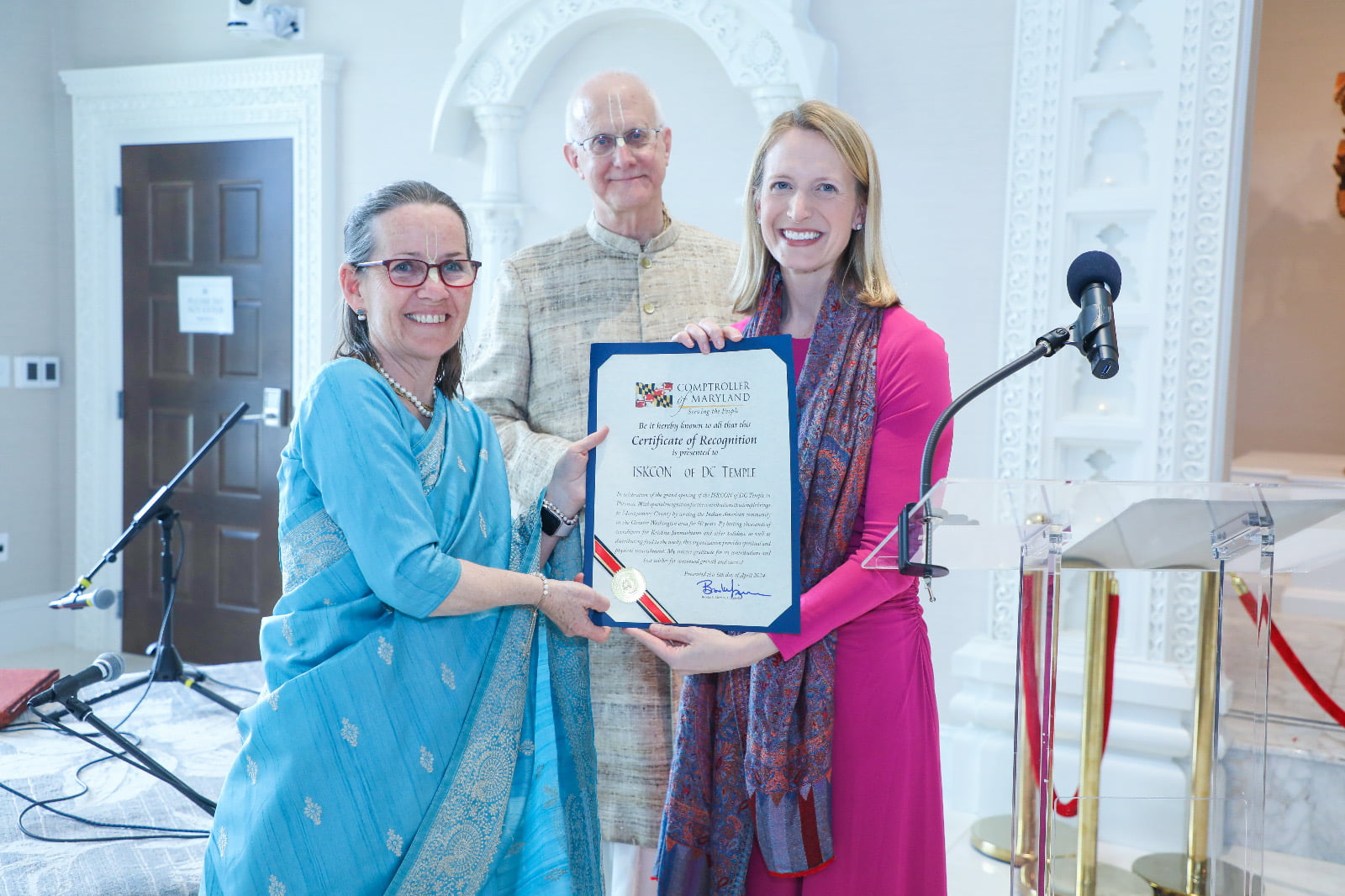
(L-R) Ananda Vrindavan Dasi and Director Anuttama Dasa accept recognition from Brooke E. Lierman, Comptroller of the State of Maryland.
As a participant in the Annual Vaishnava Christian Dialogue, I was blessed to attend the dedication of a new Hindu Temple and subsequent Dialogue LOVING YOUR ENEMY, convening on the weekend of April 12th through 14th 2024. The article includes my notes on presentations by Professors Patrick Beldio (Catholic), a scholar of comparative religion and theology with a focus on Hindu-Christian studies, and Vaishnava – Madana-Gopala Dasa (Mehul Barot), a Hindu and Kenya native, who serves as the North American Co-Director of ISKCON Communications, focusing on Hindu and media relations.
LOVING YOUR ENEMY – Hindu and Christian Perspectives
Our Dialogue began with two excellent, well-thought-out presentations by Hindu scholar Madana-gopala Dasa (Mehul Barot) and Catholic professor Patrick BelDio. Both asserted the centrality of love for all human beings and all of Creation. All love must be grounded in Love for God as each tradition dictates. Madan-goplas reasserted Vaishanava’s MONOTHEISM, insisting that the various gods, goddesses, and saints, incarnations, or manifestations of THE ONE. [1] In addition, it is important to note that Vaishnava is the dominant form of Hinduism throughout the world.
Patrick Beldio, a Catholic who interweaves his faith with comparable Hindu spirituality, presented Jesus’ statements in the Gospels, e.g.
“Love your Enemies, Do good to those who hurt you, Bless those who curse you, Pray for those who mistreat You”)[2]
He then offered an overview of Church History noting the contradictory behavior of the Church in the World.
Interestingly, while illuminating steps we can take toward loving our enemies, both men referenced the practical needs of self-defense and fighting against an adversary when necessary. With a brief summary of Church History, Professor Beldio asserted his preference for sustaining the “JUST WAR THEORY” — first articulated by Saints Augustine of Hippo (354-430) and later by Saint Thomas Aquinas (1225-1274) among others. However, all of the writings Beldio cited emphasized war as a “last resort” –after conflicting parties exhausted all efforts toward peaceful settlements.
Professor Dasa noted the foundational Hindu text Bhagavad Gita which, while emphasizing LOVE ABOVE ALL THINGS, allowed for warfare when the oppressor was inordinate in causing suffering. In fact, the spiritual epic “Gita” for short, opens with the assembling of armies! But a subsequent dialogue ensues between Patha (Arjuna), son of Pandu, and Lord Krishna, provides context:
Arjuna said:
“How shall I
In battle against
Bhishma and Drona,
O Madhusudana,
Fight back with arrows
against those who
are worthy of respect,
O Slayer of the Enemy? “
After a long discourse comprising several chapters, “The Beloved Lord” said:
The Dialogue participants included 15 Christians comprising Roman Catholics, Presbyterian, Non-denominational, and unaffiliated Christians and 11 Vaishnava , including many who practice Bakhti Yoga. Our conversations morphed into a discussions on the concept of Justice, Fairness, and heavenly realities that alone can bring about a perfect reconciliation among peoples. Each tradition made use of the term “GRACE” and/or its equivalents, emphasizing our mutual belief that no good whatsoever comes about without help from God.
Debate ensued as to whether there could be any “just war,” as per recent written letters, reflections, and homilies from Popes John Paul II to Francis. Roman Catholic participants affirmed that our tradition is advancing the consensus that, with all the advanced weaponry and war machinery sequestered in international governments’ arsenals, there can be no “just war.” The devastations that ensue, even at the smallest levels, bring pain and suffering beyond humanity’s ability to heal in the present context or in the future.
Mercy and compassion are Hindu hallmarks that empower the love of enemies. With the help of Krishna, the devout Hindu strives to be ever-loving, even amid conflicts. Nevertheless, one must confront evil and wrongdoing and be ready to act against it–even if violence ensues.
Referencing both ARJUNA in the Bhagavad Gita and Jesus in the Gospels, Dasa reiterated “Love does not exclude violence in some contexts.” He cited this quote from the Bhagavad-Gita 2: 29-39; 36b, “The embodied, eternally indestructible, dwells within the body of everyone, O Bharata. Therefore, you should not grieve for any living being. . .Therefore, rise up, O Kaunteya, acting with firm resolve for battle. Acting the same in happiness and suffering, gain and loss, victory, and defeat, Then prepare for battle—thus you shall not suffer misfortune.” (Graham M. Schweig translation. See footnotes.)
In support of his position, Dasa quoted Jesus in Matthew 10 vs. 34, interpreting it as an acceptance of sin and conflict even in a Christian context: “34 “Do not suppose that I have come to bring peace to the earth. I did not come to bring peace, but a sword. 35 For I have come to turn “‘a man against his father, a daughter against her mother, a daughter-in-law against her mother-in-law—36 a man’s enemies will be the members of his own household.’[c]
Patrick BelDio summarized his emphasis on Christian perspectives.
Violence is the tragic consequence of sin, which is inevitable in this world. We can only conquer our violent tendencies with God’s grace which, tragically, many reject. Furthermore, situations require self-defense, and even aggression may be justified to stop a greater evil. He also cited. Matthew’s Gospel 10: 34 -36. Jesus: A Cause of Division, while clarifying that the passage does not justify violence (including emotional violence, particularly within families) but recognizes its reality in our fallen state of sin. . 34 “Do not think that I have come to bring peace upon the earth. I have come to bring not peace but the sword. 35 For I have come to set a man ‘against his father, a daughter against her mother, and a daughter-in-law against her mother-in-law; 36and one’s enemies will be those of his household.’ (New American Bible, Revised Edition translation)
The ensuing dialogue acknowledged disagreements in the interpretations of texts cited, at the same time, affirmed a consensus:
It is necessary that people of faith continually discern our own culpability in contributing to seeds of hatred and acknowledge our inward motivations toward violence. Faith requires a personal confession that our attempts at objectivity are forever flawed as all are enmeshed in any given problem and its context. Thorough evaluation of the causes of enmity must be embraced with honesty and humility –both virtues -and all the other virtues — are essential to bring the perpetuation of violence to an end.
Surrender to Grace is paramount and is the foundation of all virtues.
The role of Lament regarding the thoughts and feelings in our hearts and our own actions that have harmed others must be experienced as the first step toward “loving one’s enemies.” Self-scrutiny –seeing other persons, other nations, and their policies within the realm of our own personal, national, and international failings – is required to begin the process of seeing others as fallible human beings as ourselves, and thus capable of “being loved.” All paths to forgiveness, accountability, and reconciliation must be rooted in our common humanity.
“Restore. Repair. Recompense. Reparations” is a good mantra to embrace once people have resorted to violence. It evidences appropriate accountability.
From Pope Saint John Paul II: “There is no peace without justice, no justice without forgiveness.” [4]
[1]Vaishnavism – Wikipedia See also this summary from Microsoft Copilot: “Vaishnavism is one of the major traditions within Hinduism, devoted to the worship of Vishnu and his avatars, particularly Krishna and Rama.
In the context of monotheism, Vaishnavism can be seen as both monotheistic and monistic. Here is how:
Monotheism: Vaishnavites believe in a single, supreme God, Vishnu, who manifests in various forms and avatars. This belief aligns with the concept of monotheism, where there is one ultimate divine being.
Monism: While Vaishnavism recognizes the diversity of deities and their manifestations, it ultimately views them as different aspects of the one supreme reality. This aligns with monistic philosophies that see all diversity as ultimately rooted in a single, unified existence.”
We often are intimidated sharing our faith and values with others in today’s climate of polarization, vitriol, war and violence. The Jesuits named below entered just such an environment in what is now Eastern Canada and Albany New York from 1642 through 1649.
The rivalry between the Iroquois and the Huron tribes, also known as the
Beaver Wars, was a series of conflicts fought intermittently during the 17th century.
The Iraquois Confederacy, consisting of the Mohawk, Seneca, Onondaga, Cayga, and Oneida tribes, sought to dominate the fur trade routes controlled by Huron Wendat Confederacy, allied with the French, controlled these lucrative trade routes. The Martyrs remembered today worked among Hurons. The Beaver Wars were not just about trade but also
Cultural Differences:
Political Alliances:
Fear of Colonization:
Resistance to Change:
Violence and Retaliation:
It is helpful to remember the priests were not killed only because of their religion but because of the realities of fears and conflicts that existed through all the ages, down to this day. The world’s ways wag on, but faith, hope, and love will endure as we make these virtues the heart of our lives.
The first of the Jesuit missionaries to be martyred was René Goupil in 1642. He was tomahawked for having made the sign of the cross on the brow of some children.
October 18, 1646 Father Jogues was tomahawked and beheaded. Jean de Lalande was killed the next day at Ossernenon, a village near Albany, New York.
Father Anthony Daniel, working among Hurons was killed by Iroquois on July 4, 1648. His body was thrown into his chapel, which was set on fire.
Jean de Brébeuf composed catechisms and a dictionary in Huron, and saw 7,000 converted before his death in 1649. He authored the pensive HURON CAROL. Having been captured by the Iroquois, Father Brébeuf died after four hours of extreme torture.
Father Charles Garnier was shot to death in 1649 as he baptized children and catechumens during an Iroquois attack.
Father Noel Chabanel also was killed in 1649.
Gabriel Lalemant had taken a fourth vow—to sacrifice his life for the Native Americans. He was horribly tortured to death along with Father Brébeuf.
There are two Churches honoring the martyrs. One is in Auriesville, New York and the other is The Martyrs’ Shrine is located in Midland, Ontario, near the site of their missionary work among the Huron (Wendat) people.




 frjamesdiluzio