Homily for the 20th Sunday in Ordinary Time 2025

Rev. James M. DiLuzio CSP

The Gospel was, is, and always will be the GREAT REVERSAL, a re-ordering of the flawed foundations of society. God designed it to “go against the grain,” “swim against the downstream flow,” insisting that in every age “death and resurrection,” or, in secular terms, “improvements in the human condition and mindset in confluence with the True God,” be achieved. The goal, of course, is PEACE, JUSTICE, HARMONY, RECIPROCITY AMONG PEOPLES united in Love of God and Neighbor. But Jesus, ever-the-realist as affirmed by the beautiful phrase in John’s Gospel, chapter 2: who “did not need anyone to testify about human nature. He himself understood it well,” recognized true peace comes with a price. The Crucifixion itself made that very clear.    

The Roman Empire did not welcome new perspectives on how to view human nature beyond their own vision of Emperor as god, and a hierarchy of aristocracy, soldiers, merchants, and plebians. Of course, the Holy Spirit is active in all times and places, and there were some Roman Senators inspired to act on behalf of the poor — mostly field hands and laborers, but that depended on individual Senator’s personalities and his political objectives. Beyond that, should “the lowly be lifted up,” according to the Virgin Mary’s MAGNIFICAT, the needs of the poor could be considered treachery. Moreover, Rome was wary of Jewish prophets and religious leaders –often suspect of sedition. Add to that, Jesus was critical of aspects of the Temple Cult –as were some pharisees at that time—and criticism, should it be realized, would prove detrimental to  both the Sadducees and the Romans in their delicate, frail, and fragile collaboration on taxes, tourism, immigration and other matters.         

But the “blazing fire” and ruptures to family life – ‘father against son; mother against daughter” that Jesus anticipates here is the age-old disruption of differing religious and political views within a family, among neighbors, and within society at large. Even before Jesus, the diversity in Jewish beliefs and practices caused friction withing the religious and political realms. The Hebrew Scriptures and the Gospels make clear that  people differed on Messianic expectations, and in a belief in life after death. Roman paganism highlighted eternity only for Emperors and an elite group, and belief in Resurrection from the dead was a public conflict between Sadducees and Pharisees. When some members of a family insisted on Jesus as Messiah who rose from the dead – well, claiming certainty about these matters provoked great conflict. 

These and other religious, social and political contentions are evident in our times as well–when religion and political discussions are either avoided, conclude in brutal condescension, or erupt violent altercations emotionally and/or physically–we have a sense on what Jesus meant. THE GOSPEL’s Great Reversal is an insistence that Christian Values of Ten Commandments and the Beatitudes – extensions and clarification of the Two Great Commandments: Love of God and Love of Neighbor as we love ourselves and care for our families, must remain the foundation of life. For our faith to be practiced diligently, we must evaluate issues of economy, labor, religious freedom, social norms on the Golden Rule criteria. No society past or present has fully realized these essential Gospel values. How may we contribute to their advancement in our life span? That is the essential Catholic question for today. For until that time when all societal, communal, and international laws and practices are continually evaluated by Love of God and Neighbor, patient perseverance and HOPE must remain steadfast. Indeed, we all have a good deal of work ahead putting our faith into practice, and Jesus will help us through sacrament and inspiration.   And this is the Jubilee Year of HOPE to help solidify  this concept in our hearts and minds. In this era of constant scapegoating — blaming individuals or groups for all our problems rather than collaborating on addressing the issues, no one person or group warrants Crucifixion or its counterparts in prejudice, or the human causes or emotional and physical suffering for the advancement of others, don’t you agree? 

Remember, the prophet Jeremiah suffered for speaking out on God’s behalf – thrown as he was into a cistern of mud, and, if we truly believe Jesus died “once for all,” alleviating suffering remains the challenge for our age, too.  We must not be afraid. Let these words from today’s Letter to the Hebrews echo in our hearts: “In your struggle against sin
you have not yet resisted to the point of shedding blood,” knowing that Jesus did resist, and shares his body and blood with us to strengthen in us courage, faith, hope, and love. 

LOVING YOUR ENEMY – Vaishnava-Christian Dialogue April 2024 and the Dedication of a New Iskcon Temple Community Potomac, MD

(Note: this article will appear in my Ecumenical and Multi-Faith Relations Office TOGETHER IN HOPE Newsletter for WINTER 2024-2025)

Guests listen attentively to speakers while under a stunning white and gold Lotus ceiling with the Sun shining its blessings on the event from the windows above.

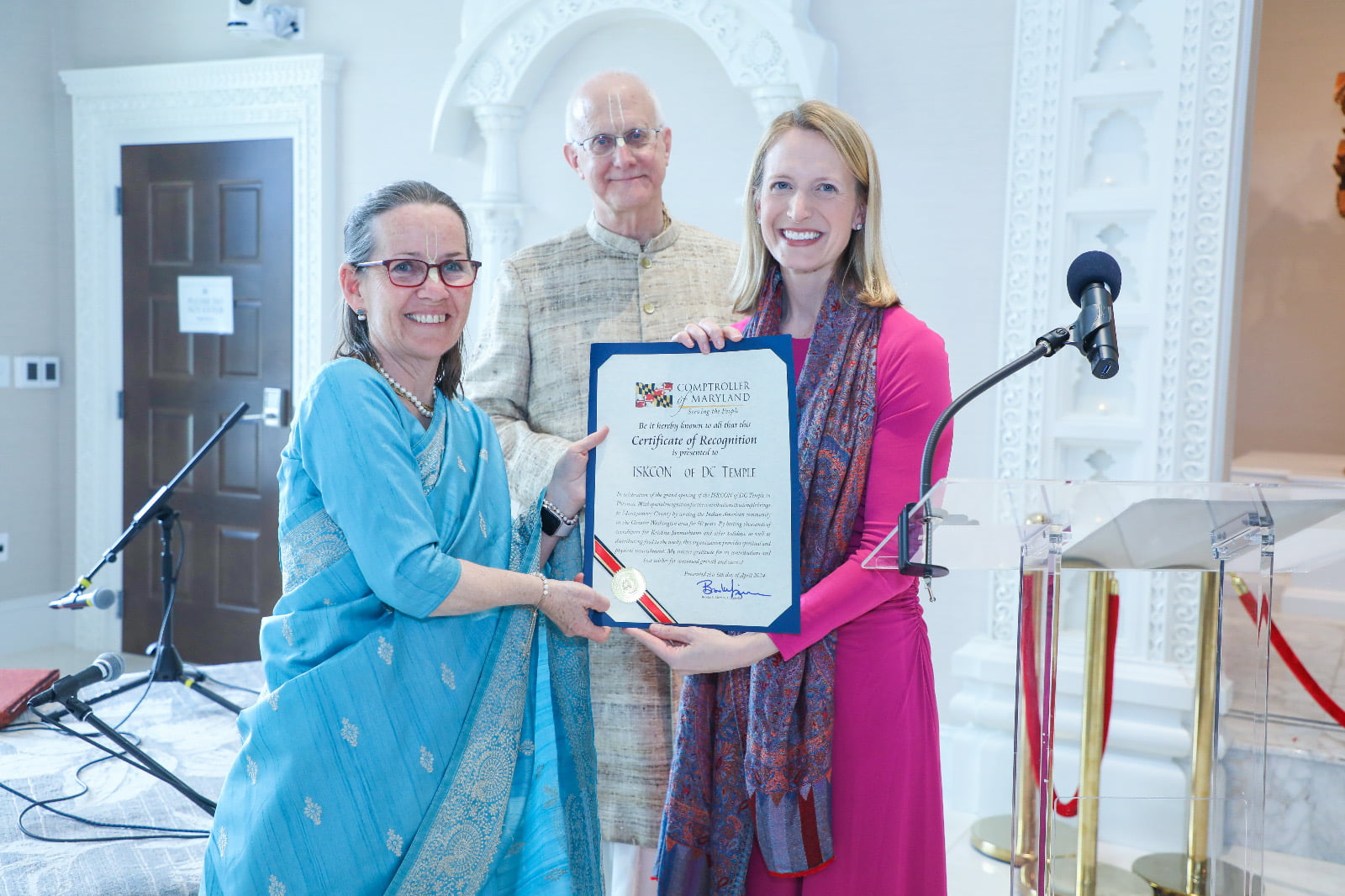
(L-R) Ananda Vrindavan Dasi and Director Anuttama Dasa accept recognition from Brooke E. Lierman, Comptroller of the State of Maryland.

As a participant in the Annual Vaishnava Christian Dialogue, I was blessed to attend the dedication of a new Hindu Temple and subsequent Dialogue LOVING YOUR ENEMY, convening on the weekend of April 12th through 14th 2024.  The article includes my notes on presentations by Professors Patrick Beldio (Catholic), a scholar of comparative religion and theology with a focus on Hindu-Christian studies, and Vaishnava – Madana-Gopala Dasa (Mehul Barot), a Hindu and Kenya native, who serves as the North American Co-Director of ISKCON Communications, focusing on Hindu and media relations.

Also See:

LOVING YOUR ENEMY – Hindu and Christian Perspectives

Our Dialogue began with two excellent, well-thought-out presentations by Hindu scholar Madana-gopala Dasa (Mehul Barot) and Catholic professor Patrick BelDio. Both asserted the centrality of love for all human beings and all of Creation. All love must be grounded in Love for God as each tradition dictates. Madan-goplas reasserted Vaishanava’s MONOTHEISM, insisting that the various gods, goddesses, and saints, incarnations, or manifestations of THE ONE. [1] In addition, it is important to note that Vaishnava is the dominant form of Hinduism throughout the world.

Patrick Beldio, a Catholic who interweaves his faith with comparable Hindu spirituality, presented Jesus’ statements in the Gospels, e.g.

“Love your Enemies, Do good to those who hurt you, Bless those who curse you, Pray for those who mistreat You”)[2]

He then offered an overview of Church History noting the contradictory behavior of the Church in the World.

Interestingly, while illuminating steps we can take toward loving our enemies, both men referenced the practical needs of self-defense and fighting against an adversary when necessary. With a brief summary of Church History, Professor Beldio asserted his preference for sustaining the “JUST WAR THEORY” — first articulated by Saints Augustine of Hippo (354-430) and later by Saint Thomas Aquinas (1225-1274) among others. However, all of the writings Beldio cited emphasized war as a “last resort” –after conflicting parties exhausted all efforts toward peaceful settlements.

Professor Dasa noted the foundational Hindu text Bhagavad Gita which, while emphasizing LOVE ABOVE ALL THINGS, allowed for warfare when the oppressor was inordinate in causing suffering. In fact, the spiritual epic “Gita” for short, opens with the assembling of armies! But a subsequent dialogue ensues between Patha (Arjuna), son of Pandu, and Lord Krishna, provides context:

                          Arjuna said:

                        “How shall I

                                    In battle against

                                    Bhishma and Drona,

                                    O Madhusudana,

                        Fight back with arrows

                                    against those who

                                    are worthy of respect,

                        O Slayer of the Enemy? “  

             After a long discourse comprising several chapters, “The Beloved Lord” said:

                        “For protection of the virtuous

                                    And for the destruction of evil acts,

                        For the purpose of establishing dharma,

                                    I become fully manifest age after age.” [3]

The Dialogue participants included 15 Christians comprising Roman Catholics, Presbyterian, Non-denominational, and unaffiliated Christians and 11 Vaishnava , including many who practice Bakhti Yoga. Our conversations morphed into a discussions on the concept of Justice, Fairness, and heavenly realities that alone can bring about a perfect reconciliation among peoples. Each tradition made use of the term “GRACE” and/or its equivalents, emphasizing our mutual belief that no good whatsoever comes about without help from God.

Debate ensued as to whether there could be any “just war,” as per recent written letters, reflections, and homilies from Popes John Paul II to Francis. Roman Catholic participants affirmed that our tradition is advancing the consensus that, with all the advanced weaponry and war machinery sequestered in international governments’ arsenals, there can be no “just war.” The devastations that ensue, even at the smallest levels, bring pain and suffering beyond humanity’s ability to heal in the present context or in the future.

Madana-gopala Dasa summarized Vaishnava’s perspective:

  • Mercy and compassion are Hindu hallmarks that empower the love of enemies. With the help of Krishna, the devout Hindu strives to be ever-loving, even amid conflicts. Nevertheless, one must confront evil and wrongdoing and be ready to act against it–even if violence ensues.
  • Referencing both ARJUNA in the Bhagavad Gita and Jesus in the Gospels, Dasa reiterated “Love does not exclude violence in some contexts.” He cited this quote from the Bhagavad-Gita 2: 29-39; 36b, “The embodied, eternally indestructible, dwells within the body of everyone, O Bharata. Therefore, you should not grieve for any living being. . .Therefore, rise up, O Kaunteya, acting with firm resolve for battle. Acting the same in happiness and suffering, gain and loss, victory, and defeat, Then prepare for battle—thus you shall not suffer misfortune.” (Graham M. Schweig translation. See footnotes.)
  • In support of his position, Dasa quoted Jesus in Matthew 10 vs. 34, interpreting it as an acceptance of sin and conflict even in a Christian context: “34 “Do not suppose that I have come to bring peace to the earth. I did not come to bring peace, but a sword. 35 For I have come to turn “‘a man against his father, a daughter against her mother, a daughter-in-law against her mother-in-law—36 a man’s enemies will be the members of his own household.’[c]

Patrick BelDio summarized his emphasis on Christian perspectives.

  • Violence is the tragic consequence of sin, which is inevitable in this world. We can only conquer our violent tendencies with God’s grace which, tragically, many reject. Furthermore, situations require self-defense, and even aggression may be justified to stop a greater evil. He also cited. Matthew’s Gospel 10: 34 -36. Jesus: A Cause of Division, while clarifying that the passage does not justify violence (including emotional violence, particularly within families) but recognizes its reality in our fallen state of sin. . 34 “Do not think that I have come to bring peace upon the earth. I have come to bring not peace but the sword. 35 For I have come to set a man ‘against his father, a daughter against her mother, and a daughter-in-law against her mother-in-law; 36and one’s enemies will be those of his household.’ (New American Bible, Revised Edition translation)

The ensuing dialogue acknowledged disagreements in the interpretations of texts cited, at the same time, affirmed a consensus:

  1. It is necessary that people of faith continually discern our own culpability in contributing to seeds of hatred and acknowledge our inward motivations toward violence. Faith requires a personal confession that our attempts at objectivity are forever flawed as all are enmeshed in any given problem and its context. Thorough evaluation of the causes of enmity must be embraced with honesty and humility –both virtues -and all the other virtues — are essential to bring the perpetuation of violence to an end.
  2. Surrender to Grace is paramount and is the foundation of all virtues.
  3. The role of Lament regarding the thoughts and feelings in our hearts and our own actions that have harmed others must be experienced as the first step toward “loving one’s enemies.”  Self-scrutiny –seeing other persons, other nations, and their policies within the realm of our own personal, national, and international failings – is required to begin the process of seeing others as fallible human beings as ourselves, and thus capable of “being loved.”  All paths to forgiveness, accountability, and reconciliation must be rooted in our common humanity.
  4. “Restore. Repair. Recompense. Reparations” is a good mantra to embrace once people have resorted to violence. It evidences appropriate accountability.
  5. From Pope Saint John Paul II: “There is no peace without justice, no justice without forgiveness.” [4]

[1] Vaishnavism – Wikipedia   See also this summary from Microsoft Copilot: “Vaishnavism is one of the major traditions within Hinduism, devoted to the worship of Vishnu and his avatars, particularly Krishna and Rama.

In the context of monotheism, Vaishnavism can be seen as both monotheistic and monistic. Here is how:

  1. Monotheism: Vaishnavites believe in a single, supreme God, Vishnu, who manifests in various forms and avatars. This belief aligns with the concept of monotheism, where there is one ultimate divine being.
  2. Monism: While Vaishnavism recognizes the diversity of deities and their manifestations, it ultimately views them as different aspects of the one supreme reality. This aligns with monistic philosophies that see all diversity as ultimately rooted in a single, unified existence.”

[2] The Gospel of Luke 6 vs 27.

[3] Taken from BHAGAVAD GITA – The Beloved Lord’s Secret Love Song, translated by Graham M. Schweig, © 2007, Harper Collins, New York NY. pp 36, and 71, Chapters 2 and 4, respectively.

[4] XXXV World Day For Peace 2002, No peace without justice, no justice without forgiveness | John Paul II

GOOD SHEPHERD SUNDAY HOMILY

Homily by Fr. James DiLuzio 

We live in an angry age. Disputes abound. Collaboration is labeled “compromise” –now an almost derogatory word as if one is “selling oneself out,” and people work so hard to manifest their “brand,” that they dig their heels into the ground, unmovable, intractable, hard-pressed any dimension of our basic, common humanity. Who can lead us out of the single-minded confines of our own willfulness? 

In another angry time, the Catholic Church was fearful of change. Almost every attempt at spiritual renewal was suspect. Onto that 13th century stage appeared two who would eventually become Saints. Their names were Francis and Dominic, each with new vision of God’s care for us, a new emphasis on how to address some of the problems of their age. One of the stories about Saint Francis continues to offer insights. Entitled  “The Tale of the Wolf of Gubbio.”  Gubbio was and is an Italian  village, in the Umbria region of Italy.  At that time, a  wolf was terrorizing  the entire population, attacking sheep, chickens, howling nightly inhibiting sleep, growling so forcefully that all were afeared of going out at night to visit their relatives and neighbors. For the longest time, they commissioned their best hunters, expert marksmen to hunt the wolf and rid them of it, but to no avail.  

Eventually word of a holy man who praised God continually for life—human life and the life of all creatures, who allegedly spoke to animals, reached their village. After much prayer and penance, almost miraculously, some villagers encountered  Francis walking in the forest. Explaining their situation with heartfelt urgency, they pleaded with Francis to come to their aid. Looking lovingly upon them all and said, “Feed your wolf.”  What? was their incredulous reply.  “Feed your wolf,”  is all he said. 

 That night villagers put plates of their leftovers on every doorstep. The wolf’s howling ceased. The next night, in thanksgiving, they placed choice meats and vegetables, and not a sheep was lost. The third night, no sounds from the hen house, and in the morning, they found Francis in the town square, the wolf bowing before the Saint. The wolf became the friend of Gubbio and good be found gnawing on bones and choice meats at all the village festivals. Ω

“Who is the wolf in this story?”  Who is the wolf? “WE are the Wolf.”  Who will  feed us in our anger, our confusion, our fears?  Who will free us from our hateful thoughts?  Today is  Good Shepherd Sunday, reminding is we have here one—and only one– acceptable answer:  Jesus, our Christ. Jesus  took on every aspect of our human nature, underwent every temptation to say to our angry selves: “Hello. I know you — everything about you. Even as you dwell in your dark abode, I have love for you, and I will patiently guide you through every wicked thought, every hopeless feeling. I will fulfill for you, even now, the words of the 23rdPsalm: “Yea though you walk in the valley of death, I will be at your side, to guide you through your anger and temptations to hate, to rage, to despair,” not with condemnation but with redemption. You, too, shall be resurrected. 

Do we think our times are any different from Jesus’ times, or different from any other century “in the course of human events?” Violence, hate, prejudice, fear, human willfulness,  are everywhere and always will be taking hold of us, and others—whenever we are at our most desperate. Fear, lack of trust in God’s timing, God’s providence, frequent failures to acknowledge a vibrant Holy Spirit present amid sin and sadness, instead we lash out, howling  like hungry wolves, losing lost touch with our common humanity. Now is the time we stop justifying our wrath as if we are participating in the wrath of God? The Wrath of God? “Judgement is Mine,” says the Lord, and  Jesus makes clear that “The wrath of God” nothing more than “zeal for souls.”  That’s your soul. That’s mine. 

Jesus  doesn’t condemn us for these thought and feelings, but he does ask us to work with him before we act upon them. Therefore, we need not be afraid to bring even our darkest thoughts and vengeful wishes to Him in prayer, in meditation, and in confession be a priest or anyone we can trust. Saint Paul repeated confirmed time and time again, “Nothing separates from the love of God that comes to us in Christ Jesus.”  Let’s admit, only weeks ago, we cried “Crucify Him, Crucify Him,” and now, in this Fourth week of Easter and Jesus says to us, “Let me Resurrect you. Let me bring you to fullness of life and the peace that only I can give.” He does this by feeding us. He feeds us with His Very Being, in this and every Eucharist.  If we let Him, He will shepherd us today, tomorrow, and the next day, just as He did for the disciples before and after His Resurrection, even as they found, and we, too, may find ourselves in an angry world.

HOLY SATURDAY Meditation from Rachel Held Evans

An inspirational meditation for Holy Saturday from Rachel Held Evans, from her book Searching for Sunday: Loving, Leaving, and Finding the Church:

“Lately I’ve been wondering if a little death and resurrection might be just what church needs right now, if maybe all this talk of waning numbers and shrinking influence means our empire-building days are over, and if maybe that’s a good thing.

Death is something empires worry about, not something gardeners worry about. It’s certainly not something resurrection people worry about.

G. K Chesterton put it this way: “Christendom has had a series of revolutions, and in each one of them Christianity has died. Christianity has died many times and risen again; for it had a God who knew the way out of the grave.” I don’t know exactly what this new revolution will look like, but as the center of Christianity shifts from the global West to the global South and East, and as Christians in the United States are forced to gauge the success of the church by something other than money and power, I hope it looks like altars transforming into tables, gates transforming into open doors, and cure-alls transforming into healing oils. I hope it looks like a kingdom that belongs not to the rich, but to the poor, not to the triumphant but to the meek, not to the culture warriors but to the peacemakers. If Christianity must die, may it die to the old way of dominance and control and be resurrected to the Way of Jesus, the Way of the cross. (pp 225-226)

As the shape of Christianity changes and our churches adapt to a new world, we have a choice: we can drive our hearses around bemoaning every augur of death, or we can trust that the same God who raised Jesus from the dead is busy making something new. As long as Christians are breaking the bread and pouring the wine, as long as we are healing the sick and baptizing sinners, as long as we are preaching the Word and paying attention, the church lives, and Jesus said even the gates of hell cannot prevail against it. We might as well trust him, since he knows a thing or two about the way out of the grave.

“New life starts in the dark,” writes Barbara Brown Taylor. “Whether it is a seed in the ground, a baby in the womb, or Jesus in the tomb, it starts in the dark.”

More on Rachel Evans here:

https://www.wikiwand.com/en/Rachel_Held_Evans

LIVING IN THE ETERNAL NOW

GOSPEL OF JOHN 3: “everyone who believes in him may have eternal life.”

From anxiety to eternity, fear to freedom

At waking, before the demands of the day enter our consciousness, we know who we are and who we are before God. Our being is one with Being, with God, I AM. This is a window into eternity; this is heaven come down to earth. This is eternal life’s prelude. The journey of Faith from Lent to Easter insists we keep cultivating this heavenly reality every day, every week, every month – beyond any liturgical season, every year of our lives.  How can this be done? Not by our own merits, but our openness to grace, to allow ourselves to be caught up in the eternal verities. 

The Scriptures tell us Abraham surrendered in just that way, in the passage about the STARS in THE SKY. Recall:  

GENESIS 15: GOD’S PROMISE TO ABRAHAM

  • But Abram said, “Lord God, what can you give me, if I die childless and have only a servant of my household, Eliezer of Damascus?” 3 Abram continued, “Look, you have given me no offspring, so a servant of my household will be my heir.” 4 Then the word of the Lord came to him: No, that one will not be your heir; your own offspring will be your heir.  5 He took him outside and said: Look up at the sky and count the stars, if you can. Just so, he added, will your descendants be. Abram put his faith in the Lord, who attributed it to him as an act of righteousness.[b]

At first, Abram’s encounter with God was all about Abram – Abram’s concerns, what Abram needed, what Abram was lacking. But then he silenced his own voice and listened to God. The vision of the Stars of heaven helped faith take hold.  Hope became a reality to be lived, savored, and returned to time and time again.

In our first reading we heard the misery of the people exiled, strangers in strange lands. Yet they did not become so caught up in their misery not to recognize the voice of God in a new empire arising: Cyrus, the Persian, inviting people to return to their own lands and worship their own God. Some will choose to stay in their misery, some will return and find new life. 

Analogous events are presented to us every day. Not to get so caught up in our woes and misfortunes that we miss the call to choose hope and PEACE in the moment –a vision of eternity accessible in the here and now. Yes, God’s realm, “the kingdom” requires our attention, and eternity will tend to us if we get out of our own way. The Sacraments are our opportunities to experience heaven here and now, and our touchstones to feel heaven’s presence again, later today, tomorrow, and the next day. One hour of peace a week is not enough for anyone! We must surrender to Christ’s peace continually. This is what Saint Paul meant when he wrote “you will be saved by faith.”

This is what the Church means when she says the Sacraments engage us in eternal verities.  Of course, it is not a matter of our concentration alone. No, it is  – far more a surrender to the Christ who knows our humanity better than we do. The best we can do is admit our distractions, worries, fears at Mass, and merge them into our prayer, consciously asking  Jesus for His help in making us present to deeper realities—seeing our needs in a bigger context.  

A PARENT with an infant: first objective may be to get the child to sleep so mom or dad could get back to  paying bills, or cleaning up dinner, or making phone calls. But when the child smiles and stares into their eyes, they have an opportunity for something greater. There’s eternity in the child’s smile, his or her sparkling eyes. All the work to be done can vanishes from their minds if they let it. If they do – and it is always a choice – they will find themselves in the perfect present – that’s eternity’s realm. If they are smart, they will savor it. They will hear Jesus say, “have faith in God, and faith in me, we are engaging you in eternity.” 

And should the child cry uncontrollably, while they are trying everything possible to soothe and comfort, they might do well to think beyond that moment and recognize in one infants’ pain or fear, the pain, and fears of the universe — the cries of victims of war, of hostage, of insult and degradation. 

Perhaps, with this larger image in mind, think and feel beyond their own frustration, their own fears. Then, they may experience both irony and mystery as the parents find themselves crying along with their infant. And with that vulnerability, of feeling out-of-control, they just might allow the voice of Jesus to say again and again: “Peace I leave with you; my peace I give to you. Not as the world gives do I give it to you. Do not let your hearts be troubled or afraid.” That is when the best decisions can be made = be it for a crying child, for the parent, for anybody in distress. 

We must bring the words of Jesus to heart time and time again. Life comprises far more than just our personal thinking and doing. There is Jesus’s words and ways of thinking that insist eternity is waiting for us in the here and now. The Kingdom of God is at hand. 

Remember the words of the biblical Job, who, in the midst of his suffering cries out: “I will see God:27 I will see for myself, my own eyes, not another’s, will behold him: my inmost being is consumed with longing.”   Eternity beckons even in the most difficult of situations. 

Jesus’ words to Nicodemus are for us, too. But we must believe them, internalize them, appeal to them, surrender to them: “so that everyone who believes in him may have eternal life.” Lord, we believe! And help our unbelief!  

NEW WAY OF LOOKING AT THINGS 

Kate Chopin, a Catholic and early feminist writer of the late 1800’s, authored a short story entitled BEYOND THE BAYOU. La Folle, an African American Creole, is thirty-five years old. She lives alone, self-sufficient working her plot of land, but never crossing the bayou to engage with the world beyond her cabin. Yet she knows, that beyond a stretch of woods, the waterway that she sees is shallow, sometimes nothing more than wet sand. One could walk across it easily. Never mind! She was content, and pleased to welcome people who occasionally came to her home.  

Twenty years before our story takes place, the son of the plantation owner for whom she worked, was wounded in a gun accident in the woods. He ran to her cabin for relief. She nursed the boy into recovery.  

Now fully grown, this boy became the plantation owner himself, and, with life-long gratitude, visits La Folle  often with his wife and children. She becomes exceptionally fond of his ten-year-old son whom she calls “Cherie.” Like his father before him, Cherie goes hunting with his rifle. And he, unlike his father, brings La Folle various game, and, in return, she bakes him cakes which they eat together.  

One day, she hears his cries in the woods. Running to him from her cabin, she finds him gravely injured. His is a wound she cannot heal.  

She picks up the ten-year-old and runs frantically across the bayou for the first time in her life toward Cherie’s family home on the opposite shore. Responding to her screams, the family takes the child from her just as La Folle collapses from exhaustion. The incident leaves her near-death, but in time she recovers.  

Soon afterward, she walks across the bayou, now more casually taking in the scene, appreciating the breeze, the sounds of life all around her. She crosses to  

see Cherie, who is improving, but remains in a state of recovery. When she arrives, his parents tell her he is  

sleeping, but she chooses to wait. It is a Sunday morning, and our story concludes as La Folle sits on the front porch of the family’s house, gazing at the sunrise that hovers up and over the bayou, beyond the trees, above her cabin, smiling as she responds to the golden glow.  

Lovely story, isn’t it? Sometimes it takes a harrowing event, but change will come. Change is inevitable sometimes because of, sometimes despite us. Through necessity or by sheer will, we must claim a new set of priorities for ourselves and others. Jesus tells us repeatedly, “Your vision has to change.”  

The person with leprosy in today’s gospel was ready for change. He saw Jesus in ways that other people did not. And Jesus saw the sick fellow as others did not. One might say this alternate vision, distinct from the commonplace, brought about the person’s healing. Indeed, a different point of view can make a world of difference. 

We have heard today’s Gospel dozens of times, haven’t we? And yet disciples remain startled that Jesus says to the man after he heals him, “Tell no one.”  Why? Why would Jesus say that? The patient is healed. Reborn. Shout it out! Scream “Hallelujah!” No. Instead, Jesus says, “tell no one, “Because he is trying to convey our need to “To Wait.” “Tarry a little.” “To Ponder it.”  

Remember all the nameless people in the Gospels are meant to convey EVERYONE. So, Jesus is saying to the man and to us: 

“Think! This healing is not about You—even though it has begun with you. This healing is not about me—even though it comes through me. Your recovery is an experience of GOD. Everything is about GOD! It is a miracle, but miracles are not ends in themselves; they are beginnings. They are overtures to faith, hope, and love that originates in God.  

So, when we hear a story of a Miracle, know that Jesus is inviting us to look at the world in new way. Miracles are meant to inspire us to new ways of living. Ponder that! 

And while we are pondering this, the Gospel says Jesus tells the man: “Go show yourself to the priest.” In other words, “follow traditions, follow the religious laws and requirements of our faith, but know that even our practices, our rituals are not ends in themselves but God-decreed conduits for change, for something beyond the ordinary. They are vehicles of transportation to a heavenly realm – so that as Jesus lifts us up into a communion with the Saints, heaven comes down to earth, and we see God WITH US in all things.”  

Because God is with us in Christmas and ORDINARY TIME, in miracles and in the mundane, we can see better, live better, choose better. Through sacraments and prayer and lives lived well, Jesus beckons us beyond the world of might makes right, of intimidation, judgments, and cruelty to transform it into the Kingdom of God.  

Franciscan Friar and author Richard Rohr reminds us that the world operates at the lowest degrees of human nature. Societies often employ “the lowest level of motivations to get things going, particularly “rewards-and-punishments.” Jesus knew that this framework can only take us so far. True self-esteem and motivation must come from somewhere else. From someone else. Self-worth comes from God, and knowing each of us are part of God’s grandeur, and a plan for a better world NOW and in the Future, beckoning at every sunrise, at every horizon. 

For only Christ’s love is true love. Only faith in Christ will motivate us to see the true goods there are in this world, and– yes, although there is a lot to discourage us, there is true good here. But we need to tend it, to help it grow. And what is not good, we need to change, and we can, and we will by the grace of God. 

Making a better NOW is the Gospel. The Good News. Dying and Rising is The Kingdom of God. Although we may be afraid of it, it is Jesus’ power of true life. The only fulfilling life. The gifts of the HOLY SPIRIT are in us to reclaim, to activate today, tomorrow, and the next day.  

It is time we see this world of ours as challenging but redeemable. We must LET LOVE HAPPEN. Lent is on the horizon. It is time for a CHANGE. We need to pick up our lifeless world and run with it. Go for the goal beyond the Superbowl. Allow the kingdom of God to take precedent NOW for a better future tomorrow. As you come to the Eucharistic table today, take and eat the Vision that is for you, for me, for everyone: the Kingdom of God is at hand. 

TOGETHER IN HOPE Winter Issue 2023

Compiled by Fr. James DiLuzio CSP

As we anticipate the oncoming of WINTER in the Northern Hemisphere (I believe all our subscribers are in the Northern Hemisphere) and continue to celebrate Hanukkah, Advent, and prepare for Christmas, and Kwanzaa, I invite us to acknowledge upcoming festivals beyond our more commonly known ones. (Kwanzaa begins 16 December 2023 through 1 January 2024.) More on Kwanzaa? See: https://www.britannica.com/topic/Kwanzaa), Before you do, I invite the Christians among us to explore my blog entry: Suggestions for a CHRIST-CENTERED CHRISTMAS (Revised & Updated) But now, here’s this:

The Winter Solstice

21 December 2023  Winter Solstice. (Pagan origins but commemorated in a variety of ways by almost every religious tradition) Actually, scientists designate it as an official “moment” on a particular day and not a “day” at all. What is constant: the Northern Hemisphere’s Winter Solstice usually takes place between December 20 and 23, depending on the year. In the Northern Hemisphere, the 2023 winter solstice will occur on December 21, 10:28 p.m. EST. In the Southern Hemisphere, it will occur on June 21 at 14:58 GMT which is 10:58 a.m. EDT. Source # 1: https://starwalk.space/en/news/what-is-a-solstice

Source # 2: https://www.timeanddate.com/calendar/winter-solstice.html

Source # 3: WINTER SOLSTICE 2023 around the WORLD: https://www.rd.com/list/winter-solstice-traditions/

YULE

22 December 2023: YULE: What we used to designate as “Pagan” religions, are finding a growing number of adherents today. Along with many others, the contemporary Wicca movement celebrates YULE, marking the New Year in the Anglo-Saxon and northern traditions of Wicca. It honors the birth of the god called the “Winter Born King.” It is described as a time for ritually shedding the impurities of the past year, and for contemplating avenues of spiritual development in the year ahead. Source: Multifaith Calendar 2023 published by The Multifaith Action Society https://multifaithaction.jimdo.com/ More on “Paganism” begins with a good definition https://www.merriam-webster.com/dictionary/paganism and this website among many others: https://www.learnreligions.com/overview-of-modern-paganism-2561680

BUDDHIST WINTER COMMEMORATION

December 26: Sanghamitta Day–the Anniversary of the arrival of Sanghamitta, daughter of King Asoka, who started the Order of Nuns in Sri Lanka and brought a branch of the Bodhi Tree (which still survives in the ancient capital of Anuradhapura). It occurs on /near the Full Moon day of December

Source: Multifaith Calendar 2023 published by The Multifaith Action Society https://multifaithaction.jimdo.com/ More on this at https://en.wikipedia.org/wiki/Bodhi_Tree and, for your convenience: https://www.britannica.com/topic/Buddhism

BOXING DAY

December 26: BOXING DAY Does anyone actually remember any of the possible explanations for this observance in the UK, Canada, Australia, and New Zealand? Hint: it has nothing to do with a sport requiring gloves that takes place in a designated space encircled by a rope. https://www.britannica.com/topic/Boxing-Day

*********************************************************************************************************

PRAY FOR PEACE

As we continue to grieve the Russian-Ukranian War, the Israeli-Hamas War, and the pervasive violence evident throughout the world, I offer you this plaintive song by Judy Collins written in 1994 during the Yugoslav War 1991-2001 in the Balkans. Entitled Song for Sarajevo (I Dream of Peace), it conveys the kind of heartbreak all war should invoke along with a prayer of hope. Listening to it keeps me sensitive to human suffering in all of its forms and contexts. It engages me in prayer. Let me know what you find helpful as conduits to prayer in the comment section below.

*********************************************************************************************************

A PRAYER FOR PEACE (from Catholic Relief Service)

Lord, Father of our human family,

You created all human beings equal in dignity:

pour forth into our hearts a fraternal spirit

and inspire in us a dream of renewed encounter,

dialogue, justice, and peace.

Move us to create healthier societies,

          and a more dignified world,

          a world without hunger, poverty, violence, and war.

May our hearts be open

          to all the peoples and nations of the earth,

May we recognize the goodness and beauty

          that you have sown in each of us,

          and thus, forge bonds of unity,

          common projects, and shared dreams.

https://www.crs.org/

PLEASE ADD in the comments YOUR FAVORITE CHARITY so we may have an abundance of Multi-faith agencies at our fingertips. Perhaps, in the future, we could pledge to a friend’s agency to honor another faith or denomination’s life-giving efforts.

MORE ON WAR AND PEACE

FREE DOWNLOAD: HOW TO TALK TO JUST ABOUT ANYONE ABOUT ISRAEL PALESTINE: https://www.mybrotherfromanothermother.org/download-guide/

I became aware of this resource through an online event sponsored by https://www.sharingsacredspaces.org/ — a website we all need to “Bookmark” for the many seminars, programs, and educational tools it offers for Interfaith dialogue. The program was entitled “The Israeli-Palestinian Situation: Skills for Conflict Transformation” offered by long-time peace activist Dr. Yehezkel Landau whose website offers a multitude of resources. https://landau-interfaith.com/ AND https://www.mybrotherfromanothermother.org/

SOURCES FOR ONGOING EDUCATION – Engaging in Controversies in Conversation:

HOW DID WE GET HERE? I want to offer you a Terrific Presentation on the Modern History of the Conflict Between the Jews and Palestinian Peoples PART ONE. I attended this workshop offered by Fordham University’s Center for Jewish Studies in New York City “LIVE.” I was in awe of the way these two revered professors artfully condensed and contextualized the essential roots of the trials and suffering of two peoples that began in the 19th century. I think you will find this presentation helpful in distancing us, if only a bit, from the strong emotions the current war invokes in all who want to talk about it. I am confident we all agree that more education will help.

You may contribute to the many efforts of Fordham’s Center for Jewish Studies here: https://www.fordham.edu/academics/departments/jewish-studies/

Here are some more extraordinary websites to add to the conversation:

https://thirdnarrative.org/narratives/

BOOK CLUB 2024

I continue to ask for input on these choices for next year. WHAT IS GOD? by John Haught. The author suggests five ways of thinking realistically about God by reflecting on profound human depth experiences of the Future (aka ‘Horizon’), Freedom, Beauty, and Truth.  Dates: I will offer morning and evening sessions the WEEK OF FEBRUARY 4 through 9th. Times to be designated after all confirm their interest. Please Respond by Monday, January 15th with your available dates and preferred time frame Morning or Evening.

Available at https://www.paulistpress.com/Products/2754-7/what-is-god.aspx

In JUNE 2024, I propose we try WHAT IS RELIGION? by the same author. In this book, John Haught invites us “to uncover what it is that religions have in common: the archetypal human need to find meaningful routes through life, and to stay in touch with their spiritual potential.”

Available at 

https://www.paulistpress.com/Products/3117-X/what-is-religion.aspx

More about John Haught here: https://www.wikiwand.com/en/John_F._Haught

Passion Parade – A Meditation as well as a Review by Fr. James DiLuzio CSP of the recent Broadway Musical Revival of PARADE

PARADE – a musical theater piece by Jason Robert Brown and Alfred Uhry.

Review and Mediation by Father James DiLuzio CSP

This past weekend I began my observance of what we Christians call Holy Week by attending PARADE. This musical theatre piece dramatizes the travesty of a historical 1912 trial convicting an innocent man of murder.  The man was Leo Frank, one of the few Jewish members of an Atlanta community, sentenced to death by hanging. For two years, Lucille, his wife, and many legal and justice-oriented organizations from the north submitted appeals for Leo, until, finally, Georgia Governor John Slaton commuted the sentence to life imprisonment. Angered by the governor’s decree, a mob abducted Frank from his jail cell. Hanging from a tree, Leo reiterated his innocence and prayed the Kaddish – a prayer recited daily by devout Jews and commonly offered at burials and subsequent days of mourning. Here is one of many English translations:

“Exalted and sanctified be God’s Great Name,

in the world which God created according to His Will,

May He establish His Kingdom,

and may His salvation blossom,

and His anointed be near.”  

The tragedy of Leo Frank’s trial, the ultimate sentence, and lynching provide heartrending evidence of Antisemitism and other forms of scapegoating in the United States right down to today.  As a Catholic priest, I could not stop making connections between Leo’s story and Jesus’ trial and execution. Does not the Kaddish echo themes in many of the Psalms, especially Psalm 22 that Jesus prays while suffering on the cross? It begins with “My God, My God, why have you abandoned me?”  but concludes with these words of praise:  

“You who fear the Lord, give praise!
    All descendants of Jacob, give honor;
    show reverence, all descendants of Israel!
25 For he has not spurned or disdained
    the misery of this poor wretch,
Did not turn away[g] from me,
    but heard me when I cried out.
26 I will offer praise in the great assembly;
    my vows I will fulfill before those who fear him.”

I began wondering if Jesus’ crucifixion could be scrutinized in such a way as to conceive Jesus’ death as an example of Antisemitism along with Leo Frank’s.  The Roman empires’ disdain (albeit with tolerance) for the Jews is well documented.[1]  The Gospels portray Pilate as making no effort to reconcile the opposing factions within the Jewish religious authorities – abandoning his magisterial duty.  Was this in part due to his contempt for the Jews? (In fact, the Gospels try to show Pilate as sympathetic to Jesus because of early Christianity’s hope to gain acceptance and recognition from Rome.  But Pilate’s historical reputation does not present him as a man of integrity and compassion.) [2] As with Leo Frank’s trial, many witnesses lied and/ or were coerced in preparation for their testimonies against Jesus. In both cases, the antisemitism may be perceived as ingrained in the culture, rather than overt – i.e., no one in either crowd (if the play is accurate in this regard) cries “Kill the Jew.” More importantly, however, in both cases, the government, the state alone, has the power to execute, while hatred for a person who was “not like others”[3] reveals the failings of humanity as a whole, above and beyond any particular prejudice. That, at least, is the emphasis in the Gospel and an essential lesson of Jesus’ Passion.  Still, had our very Jewish Jesus been a Roman citizen, would there have been a trial at all, let alone an execution? Banishment, maybe. I welcome further conversation on these ideas.  

As for PARADE, the production is solid, the performances top caliber, and the plot appropriately disturbing. The title itself is filled with irony – echoing the popular public marches of John Philip Sousa (1854-1932) that engaged 19th-century Americans in displays of national pride.   Exemplifying the nation’s hubris, these marches along with Stephen Foster’s wistful parlor songs, often disguised the many prejudices of the age: slavery, racism, and the abuses of the industrial revolution.  Fittingly, Jason Robert Brown’s score evokes Sousa in most of the coral scenes – the Chorus representing the Atlanta public – proud, boastful, and blindly egocentric.  The opening ensemble piece is so over-the-top- nationalistic, I cringed throughout, anticipating at the onset, as most of us do, that this crowd will soon be transformed into a violent mob.   

To his credit, Brown uses a variety of 19th-century musical styles in addition to the musical fanfares as the plot unfolds. I found his ballads the best part of the score, especially those highlighting intimate moments between Leo Frank and his wife Lucille. The excellent Ben Platt and Micaela Diamond as the Franks shine in these scenes. In addition, Brown inserts typical Broadway show-stopping tunes to several supporting players, but I think he was misguided to feature these in a play of such importance. For example, while playing Jim Conley, a more likely murder suspect, Alex Joseph Grayson gives a bravura performance in a spirit-filled, toe-tapping song that screams for applause. But the music is set to the lyrics of his testimony against Mr. Frank that incriminate Leo so completely that the irony of the musical setting is lost. The mendacity in evidence in the number is just too painful and we are left confused as to how to respond. Only a third of the audience at the performance I attended attempted to clap.

The book by playwright Alfred Uhry could have been a bit tighter, too. Indeed, some plot points and character traits need more clarification – especially in regard to Leo’s defense attorney. Was he truly so inept? Furthermore, I would have liked more insight into Leo Frank himself as the script presents him as both an intellectual snob, a workaholic, and, at times, an utter nebbish. Uhry only allows Platt to realize Leo’s deeper humanity as he faces death.  That may be true for many of us, but the play’s overall impact offers more insights into the angry crowd’s dynamics, the governor’s cowardice, and the prosecutor’s craftiness than into Leo’s “Everyman” dimensions.  To be sure, the show offers empathy for Leo, but more in conceptual terms than profoundly personal ones.  Interestingly, because there is much in the script akin to Arthur Miller’s THE CRUCIBLE, Uhry and Parade’s producers could have paid more attention to Miller’s protagonist John Proctor, the man scapegoated by Salem’s witch-hunting magistrates.  All the same, the tragic events and elements of this story are important ones to scrutinize and evaluate, and the talents of all involved are quantitatively more in evidence than their failings.  PARADE is an essential work of theater for our time.   

Leo Frank – Wikipedia

Home – Parade (paradebroadway.com)


[1] Writing around 90 CE, the Jewish author Josephus cited decrees by Julius Caesar, Mark Antony, Augustus and Claudius, endowing Jewish communities with a number of rights.[9] Central privileges included the right to be exempted from polis religious rituals and the permission “to follow their ancestral laws, customs and religion”. Jews were also exempted from military service and the provision of Roman troops.[10] Contrary to what Josephus wants his readers to believe, the Jews did not have the status of religio licita (permitted religion) as this status did not exist in the Roman empire, nor were all Roman decrees concerning the Jews positive. Instead, the regulations were made as a response to individual requests to the emperor. The decrees were deployed by Josephus “as instruments in an ongoing political struggle for status”.[11]

Because of their one-sided viewpoint, the authenticity of the decrees has been questioned many times, but they are now thought to be largely authentic.[12][13][11][14] Still, Josephus gave only one side of the story by leaving out negative decisions and pretending that the rulings were universal.[15] This way, he carried out an ideological message showing that the Romans allowed the Jews to carry out their own customs and rituals; the Jews were protected in the past and were still protected by these decisions in his own time.  Source: History of the Jews in the Roman Empire – Wikipedia which also cites entries from The Jewish Encyclopedia: ROME – JewishEncyclopedia.com  Interestingly, however, because there was considerable “tolerance” of Judaism in Rome, the “disdain” I reference is evidenced in the ways Pilate treated the Jews of Jerusalem following precedent from other rulers. 

[2] “Josephus also recounts that Pilate raided the temple treasury for funds to construct an aqueduct; when the population again protested, Pilate arranged for his soldiers to mingle among the crowds and then, at an appointed signal, massacre them (Ant. 18:60-62).  According to Philo . . . Pilate was ‘a man of a very inflexible disposition, and very merciless as well as very obstinate . . . in respect of his corruption, and his acts of insolence, and his rapine, and his habit of insulting people, and his cruelty, and his continual murders of people untried and uncondemned, and his never-ending, and gratuitous, and most grievous inhumanity.”  Source: The Jewish Annotated New Testament, Amy-Jill Levine, and Marc Zvi Brettler, editors. New York: Oxford University Press.  The Jewish Annotated New Testament by Amy-Jill Levine, Hardcover | Barnes & Noble® (barnesandnoble.com)

[3] Book of Wisdom 2: “14 To us he is the censure of our thoughts; merely to see him is a hardship for us, 15 Because his life is not like that of others, and different are his ways.”

For more on Pilate’s Culpability for Jesus’ execution see https://www.history.com/news/why-pontius-pilate-executed-jesus?cmpid=email-hist-inside-history-onequestion-2023-0407-04072023&om_rid=21de76af3b93bfc2237c061c3efab4963e944473afe0f8a29fa6d66b32ec6c39

REFLECTING ON THE TRINITY

A Homily by Fr. James DiLuzio CSP

Holy Trinity Sunday, 11 June 2022

Blessings on this TRINITY SUNDAY: Three Persons in ONE GOD. Did you know that from ancient times, the number THREE was associated with perfection and mystery?  How fitting then to understand God in this way for the number THREE is evidenced deep in our collective conscious and unconscious selves. No surprise that we are made up of ATOMS — the smallest unity of ordinary matter, comprises three elements: neutrons, protons, and electrons. What’s more, we like to count in Threes. We speak of births and deaths in threes. Three times Four gives us TWELVE , we find an expansion of three that has tremendous connotations for FUTURE and HOPE: just as the 12 Tribes of Israel, 12 Apostles extended God’s Covenant each in their own way, to all the world. And, of course, three times eleven gives us Thirty-three –the traditional age of Jesus when his LIFE culminated in his Crucifixion and Resurrection. 

Should it be any wonder that Christians came to read the Hebrew scriptures and Christian Testaments identifying significant references to the concept of Three in understanding the centrality of relationship as the very heart of God.  Recall: the three angels / visitors to Abraham and Sarah in Mamre that confirmed God’s promise of children to the elderly couple. And, in fulfillment of Christ’s life, death, and resurrection came the realities of a new life because of a Trinitarian  Baptism Formula as Jesus said to his disciples: Matthew 28: 19 Go, therefore,[l] and make disciples of all nations, baptizing them in the name of the Father, and of the Son, and of the holy Spirit.” Most importantly, we hear the relationship of the Trinity in the following scripture passages when Jesus is remembered as saying:

Gospel of John 10: 36:The Father and I are one.”   AND that this oneness is extended to all through the Holy Spirit:

Gospel of John 14: 26:  The Advocate, the holy Spirit that the Father will send in my name —

Gospel of John 17: 21 so that they may all be one, AS you,    Father,  are in me, and I in you, that they also may be in us, that the world may believe that you sent me.

So, we came to understand ONE GOD, whose ONENESS comprises  a UNITY of THREE:  

Today’s liturgical readings give us further understanding of who the Holy Spirit is. From Proverbs’ Poem of WISDOM, we heard  “  from of old I was poured forth  at the first.. . . . . “When the Lord established the heavens, I was there, I was his delight day by day,. . . .and I found delight in the human race.”  AND from Romans 5:“because the love of God has been poured out into our hearts through the Holy Spirit that has been given to us.”

But we not only find references to the Trinity in Scripture, but in our very selves, the Triune God is imprinted in us. We may look at aspects of our humanity to understand the Mystery of the Trinity because Scripture itself invites us to:  

Genesis 1:27. God created mankind in his image; in the image of God, he created them; male and female he created them.

Colossians 1:15  The Preeminence of Christ : He is the image of the invisible God, the firstborn of all creation.

Romans 8:11If the Spirit of the one who raised Jesus from the dead dwells in you, the one who raised Christ from the dead will give life to your mortal bodies also, through his Spirit that dwells in you.

Wisdom 2:23 For God formed us to be imperishable; the image of his own nature he made us.

Now place these Scriptures in conversation with this quote from Pope Saint John Paul II from his book ON THE THRESHOLD OF HOPE:  “The Search for God and the Search for one’s True Self are one in the same search.” So, let’s examen the three-fold personhood in us to help us embrace the Mystery of the Triune God more fully.

God is WILL, and God gave us a Will . God used God’s will to CREATE, and God invites us to willfully create either through procreation, or if we choose religious life, single life, or are unable to bring forth children, to nonetheless create using our minds and talents to honor God and serve others. WILL AND CREATIVITY ARE ONE IN GOD’S ESSENCE and so in our humanity, we offer an image of GOD THE FATHER. But God is more than will and creativity, and so are we more. Infants, for example, seem to manifest will and will alone (Feed me, comfort me, clean me up), yet within them is far more –the more just needs more time to manifest itself.  Therefore, in the image of God, we are Will and more than will, and, so, too, is our God. 

The Second Person of the Trinity in God is WORD, a LOVING WORD expressed through Christ.  Humans are meant for LANGUAGE, the expression of mind and will that reaches out to fellow creatures, and communicates meaning with an invitation to connect, to relate, to befriend fellow human beings.  “IN the Beginning was the WORD, and the Word was with God, and the Word was God. And the Word became Flesh and Dwelt among us.” And Christ dwelt among us to manifest LOVE and make all our communication and the resulting relationships LOVING.  Thus, Language, when used properly, keeps us in the image of God as are words unite us to our fellow human beings.  

When we speak and connect to others, we add to our personhood in such a way that we become distinct from our mere will and creative selves.  We sometime feel as if we are a different person than what we conceive in our minds because of the friends we make, the company we keep. Thus united, we remain ourselves, but become more than ourselves, just as when God Incarnated as Jesus of Nazareth God was an enfleshed God, a unique “other,”  yet so intimately unified as to be ONE –GOD AND CHRIST TO BE INSEPERABLE.  

Now let’s look at how we may reflect the third person of the Trinity.  We all know that God is spirit, but more than just “a spirit,” because in the person of the Holy Spirit, God is driving force for ACTION, for DEEPENING RELATIONSHIP with the world.  This Spirit is not self-contained or self-serving, but generous, overflowing moving Words and Bodies into fulfillment. Therefore, when God ACTS, putting God’s WILL, CREATIVE ENERGY, LOVING LANGUAGE AND CONNECTION WITH CREATION AND THE HUMAN RACE, GOD IS HOLY SPIRIT –again, not just a dimension of God, but an actual unique PERSON of God. 

Made in God’s image, Jesus shares that same HOLY SPIRIT with us. Gospel of John 20: 22: Jesus  breathed on them and said to them, “Receive the holy Spirit. Through the Spirit, we become energized in love, in forgiveness, in fostering and repairing relationships, transcending ourselves, expanding our consciousness and self-understanding to become a New Person in Christ.  We truly are ourselves, and not ourselves when we put our relationship with God and others first and foremost above any pursuit of worldly gain or glory. Sure, not so distinct as to be another person entirely (we are still Jean or John or who knows who) but hopefully, we may get a sense that God is actually a distinct Person as Holy Spirit while remaining ONE GOD. 

And so we come to Word and Eucharist today to meditate, to dream, willing to BE One with God, saying prayers silently and aloud, engaging in ACTIONS to live in Christ and be Christ to one another, making us more conscious of the threefold reality of the Trinity. When we receive this Eucharist, we are united to God in Christ and in the Spirit, we are one with one another – different, unique, yet wonderfully common in our common humanity and our dependence on God. It’s time we chew on that some more.

Glory Be to the Father, and to the Son, and to the Holy Spirit. As it was in the beginning, is now, and forever shall be, world without end. Amen. 

First Sunday of Advent 28 Nov. 2021

By Fr. James DiLuzio C.S.P.

People of the Covenants – Jews and Christians thought the end of the world was upon them when Rome decimated the Great Temple of Jerusalem. Yet, disappointed that Messiah did not arrive, Judaism and Christianity persevered by the grace of God. Jews were saved because of their confidence in God’s faithfulness; Christians, because they believed that through all the turmoil, their Redemption was at hand.

In every age there are signs for us to interpret that engage our faith. In the Great Religious Revivals of the 19th century, many Americans thought an eclipse of the sun would inaugurate a Messianic Age.  By the “Third Great Awakening” from 1850 onward new forms of Christianity emerged: Christian Science, the Mormon Church, Pentecostal Christianity. Within the main line churches, Methodism flourished, and, within Catholicism, the Paulist Fathers were formed.  All were trying their best to address the turmoil of their times:  industrial revolutions, workers’ rights, and a host of other things.  Through it all, the people were determined to stand tall because of their faith in Jesus.  The legacies of their contributions are still with us, especially in a widely held Christian principle: that Christ will return once humanity has reformed the earth, when our surrender to God is complete and the biblical design of peace and harmony are accomplished.  Indeed, Jesus made it very clear that our heavenly goals will not be reached unless we cooperate with Grace to experience a little bit of heaven on earth.  The KINGDOM must be inaugurated before Messiah returns.  Why else would Jesus say “build my kingdom!”

That vision is for every time and place, but it must be rooted. We must always acknowledge the reality of sin—the human proclivity to cause harm. There is an inherent selfishness in humanity.  Jesus always acknowledged that. One of my favorite biblical phrases comes from the Gospel of John, chapter 2, vs 25: “Jesus did not need anyone to testify about human nature. He himself understood it well.”  Knowing this, He came to SAVE.  Amazing how his grace is offered to all who choose to hold steadfast to Him.

ADVENT begins a new year, and the signs of our times are offering new opportunities for renewal, for re-commitment to Christ. Humility is key. We must humbly acknowledge we need a Savior! Keeping our sights on Jesus, let us examine some of our most recent trials and see how we can witness to others that this new Church year is a year of grace. 

In September we commemorated the 20th anniversary of the tragedy of 9/11. Back then, most of us thought that, after the shock, and hurt, and cries for vengeance, and, after the wars (has any war ever settled all the issues for which it was declared?), we would have settled down, and taken up the cross of peace-making. Instead, in this 21st century, our nation and much of the globe remains infected with hate mongering, scapegoating, and intolerance. Did you know that sociologists have recorded that although wars unite people against a common enemy, when wars are over, domestic violence, gangs, and scapegoating minorities and others increase at alarming rates in peace time economies? Obviously, the revenge against Al-Qaeda and Osama Ben Laden did not satisfy.  That is a sign for our times worthy of our consideration.

 And now, we have lived with almost two years of the Covid epidemic. People of good will prayed and hoped that international cooperation would have been exemplary; that remedies and established protocols would have assured all humanity access to vaccines — a gift of inspiration from our God to the medical community and the world. But that is not the totality of our experience. Although great progress is being made, sin still erupts; controversy ensues. Except for those who because of health issues could not and should not be vaccinated (a small percentage of the population), there were and are people in every nation boycotting wearing masks and refusing vaccines as an expression of their individuality. A very self-serving defiance rooted in a hostile ideology that cares not for neighbors, or elderly, or apparently the young and future generations. Worse, today’s news highlights new covid mutations and pockets of pandemic spread.  Add denial of the human imprint on climate change, and it is clear the mess we are in.

Indeed, one of the worst sins of our age is denial of the sins of the past, which, in a sense, is like saying “We don’t need a Savior. We’re doing perfectly fine for ourselves.” HA! 

To those who say “Stop telling us about the sins of our past. We’re tired of hearing of the rape of the land, violence against the natives, the terrors of slavery, the abuse of children in church and homes, and poverty and all the rest.”  To those people, we must ask, “Do you or do you not value the Bible as Divine Revelation?  If you do, take note: the Bible offers more examples of sin than of glory.  Most of the Bible’s inspiration comes from naming and learning from sin and selfishness, from very human mistakes to outright denial of God and Covenant.

 Adam and Eve, Cain and Abel—shall we expurgate their stories from the text? The Golden Calf and the rebellion of the Israelites –forget it?  Jesus reprimanding James and John for wanting to get special favors; arguments among the Apostles as to which among them shall be treated the greatest – immediately following the Last Supper and the First Eucharist? Yes, better to delete all of that.  Is there nothing to learn from Jesus calling Peter “Satan,” or from Peter’s threefold denial, or the lukewarm, nausea-inducing mediocre seven churches of Revelation?  

         WISDOM comes from Truth –not half-truths.  Conversion comes from humility. Yet, for all this, the Bible’s most foundational message is how much we are loved.  It takes humility to accept that God’s Covenant comes from care; God’s forgiveness reveals loving patience. Jesus’ humanity reveals we are not only fully known, but we are never alone. Jesus understands that most of our sins are rooted in desperation, fears, and ignorance. With love, patience, and understanding –the gifts of faith—Jesus says, follow me, sin no more, and assist others in accepting love.

Advent prepares us to take stock again as to where we have been and where we are going.  Don’t we want to gaze upon the Infant Jesus in the manger and say, “Dear Jesus, I’m learning, I’m growing. Your love is reaching me, teaching me, transforming me.”

Today, all our readings insist that, no matter the era we live in, no matter the strife in our lives, that love is hope for sinful people.  Yes, our Christian faith offers tremendous redress to all that ails us. This Eucharist, this very day, is yet another opportunity for us to surrender to LOVE.  That is God’s will. To accept it, is to accept Jesus, to follow Jesus, who, as Scripture says, “shall do what is right and just in the land” and take us in that same pursuit.  

Advent.  Don’t wait!  Surrender! Our world is waiting to be loved.